Lothal : India is once again looking toward the sea to redefine its future. At a time when global trade, geopolitics, and economic growth are increasingly tied to maritime strength, policymakers and industry leaders are urging the country to reconnect with its historic ocean legacy and chart a bold path forward.
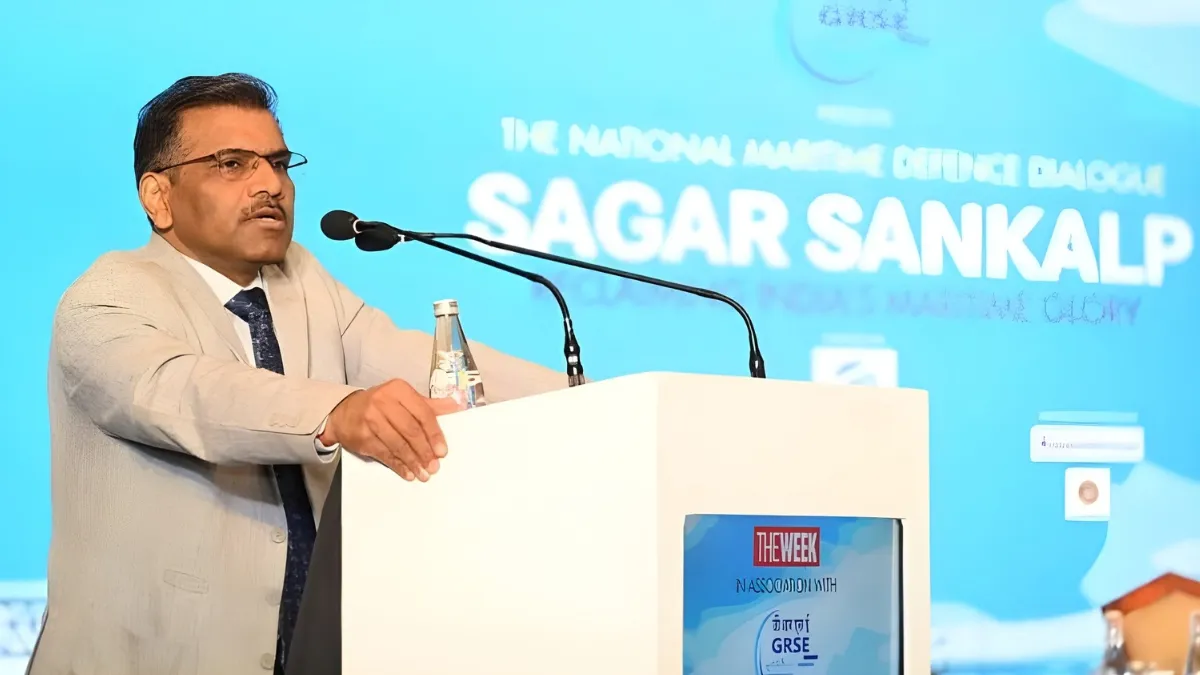
Speaking at a high-level maritime dialogue titled “Sagar Sankalp – Reclaiming India’s Maritime Glory,” senior government official Rajesh Kumar Sinha, Special Secretary at the Ministry of Ports, Shipping and Waterways (MoPSW), emphasised that India must rediscover its maritime confidence and undertake sweeping policy reforms to compete with leading maritime nations.
The discussion, organised by THE WEEK in collaboration with Garden Reach Shipbuilders and Engineers (GRSE), brought together experts, policymakers, and defence strategists to examine how India can strengthen its position in the global maritime ecosystem.
A central theme of the conversation was the importance of reconnecting with India’s ancient maritime roots—symbolised by the historic port city of Lothal—while building a modern shipping and shipbuilding industry capable of supporting the nation’s economic and strategic ambitions.
Rediscovering Maritime Pride Through Lothal
India’s maritime history stretches back thousands of years, long before modern shipping routes and international maritime regulations existed. Among the most remarkable reminders of this legacy is Lothal, an ancient port city of the Indus Valley Civilization located in present-day Gujarat.
Lothal was once a thriving maritime hub around 2400 BCE, connecting the Indian subcontinent to distant civilizations through trade networks that stretched across the Arabian Sea and beyond. Archaeological discoveries at the site—including one of the world’s earliest known dockyards—demonstrate that ancient India possessed sophisticated maritime engineering and navigation knowledge.
Today, the government is working to revive awareness of this maritime heritage through the National Maritime Heritage Complex being developed at Lothal. The project is designed to showcase India’s centuries-old seafaring traditions and maritime achievements.
During the summit, Sinha highlighted the importance of the Lothal project in shaping national consciousness about maritime history.
According to him, visiting Lothal offers a powerful reminder of India’s historic connection with the sea.
Anyone who walks through the site, he noted, cannot help but feel pride in the maritime achievements of ancient Indian civilization.
Sinha also reflected on his own experience visiting the archaeological site of Dholavira, another Indus Valley Civilization location. Such historical landmarks, he said, provide a clear perspective on how advanced India’s maritime networks once were.
These reminders of the past, he argued, should inspire India to dream bigger when it comes to building its future as a maritime power.
The Need for a Maritime Reset
Despite its vast coastline, strategic location, and growing economy, India’s role in the global shipping industry remains relatively modest.
Sinha described the current moment as one requiring a “reset” in how the country approaches maritime development.
India currently accounts for less than one percent of global shipbuilding and ship ownership, a figure that reflects a dramatic decline compared with earlier periods when Indian ports and shipbuilders were prominent players in international maritime trade.
If current trends continue, he warned, India’s share in the global shipping industry could drop even further-potentially reaching just 0.3 percent by the year 2047, when the nation marks 100 years of independence.
Such a scenario would place India at a disadvantage in a world where maritime logistics increasingly determine trade competitiveness.
For a country that handles massive volumes of imports and exports, the implications are significant.
Heavy Dependence on Foreign Ships
One of the most pressing concerns highlighted during the dialogue is India’s heavy reliance on foreign vessels for transporting trade cargo.
Approximately 96 percent of India’s export-import cargo is currently carried by ships flying foreign flags.
This dependence means that Indian businesses and exporters must pay large sums to foreign shipping companies for freight services.
According to government estimates, India spends roughly $106 billion every year on freight payments to foreign shipping lines.
Such a massive outflow of capital represents a missed opportunity for domestic maritime growth.
If more ships were owned, built, and operated by Indian companies, much of this revenue could remain within the country, strengthening the economy and creating jobs.
Government Initiatives to Boost Maritime Strength
Recognizing these challenges, the government has introduced a range of policy initiatives aimed at revitalizing India’s maritime sector.
These reforms are designed to increase domestic shipbuilding capacity, expand shipping fleets, and improve maritime infrastructure.
One of the key initiatives announced by Sinha is the Coastal Cargo Promotion Scheme.
The programme focuses on encouraging the movement of cargo along India’s coastline rather than relying solely on road and rail transportation.
Key elements of the scheme include:
- Financial incentives for coastal shipping operators
- Development of coastal infrastructure
- Skill development programmes
- Improved availability of vessels for cargo movement
By strengthening coastal shipping, the government hopes to reduce logistics costs and create a more efficient domestic supply chain.
Expanding Inland Waterways
Another major area of focus is the expansion of India’s inland waterway network.
India has officially declared 111 national waterways, but only 32 of them are currently operational.
The government aims to increase this number to 52 operational waterways by 2030.
Expanding inland waterways could significantly reduce transportation costs while also lowering carbon emissions.
Water transport is widely recognized as one of the most energy-efficient and environmentally friendly methods of moving goods.
Developing these waterways will also connect remote regions with major trade corridors, creating new economic opportunities across the country.
Strengthening Ship Repair Infrastructure
India’s maritime development strategy also includes strengthening ship maintenance and repair capabilities.
Plans are underway to establish ship repair facilities in Patna and Varanasi, two important cities located along inland waterway routes.
These facilities will support vessels operating on river transport networks while also generating employment and technical training opportunities.
In addition, the government is exploring the creation of a regional centre of excellence for inland waterways, which would focus on research, training, and innovation in river transport systems.
Encouraging Container Manufacturing
The government is also working to boost domestic manufacturing of shipping containers.
Containerisation transformed global trade in the twentieth century by enabling standardized cargo transport across ships, trains, and trucks.
However, much of the world’s container production is currently concentrated in a few countries.
By encouraging container manufacturing within India, policymakers hope to reduce dependence on imports while strengthening the country’s logistics infrastructure.
Major Legislative Reforms in the Maritime Sector
Policy reforms in the maritime sector have also included significant legislative changes.
In 2025, the government passed five major maritime laws, marking one of the most comprehensive legal overhauls in the sector in decades.
Among the most significant reforms was the modernization of the Merchant Shipping Act of 1958.
The original legislation had remained largely unchanged since the early years of India’s independence.
The updated version introduces modern regulatory frameworks designed to align India’s maritime policies with global standards.
The revised law is scheduled to come into force on March 15, with several supporting rules currently being finalized.
Other important legislative changes include:
- A new Coastal Shipping Act
- Replacement of the Indian Ports Act of 1908
- Revisions to the Bills of Lading Act
- Updates to the Carriage of Goods by Sea Act
These reforms aim to streamline maritime regulations, improve safety standards, and make India a more attractive destination for maritime investment.
Long-Term Vision for Maritime Growth
India’s maritime policy reforms are guided by two major strategic frameworks:
Maritime India Vision 2030
This roadmap outlines ambitious targets for port development, shipbuilding expansion, and logistics efficiency.
The plan focuses on improving port infrastructure, increasing cargo handling capacity, and integrating ports with industrial and economic zones.
Maritime Amrit Kaal Vision 2047
Looking further ahead, this long-term strategy aims to position India as a leading maritime power by the time the country celebrates its centenary of independence.
Key goals include:
- Expanding shipbuilding capacity
- Increasing Indian ship ownership
- Strengthening maritime infrastructure
- Developing advanced maritime technology
Together, these strategies seek to ensure that India’s maritime sector becomes a major driver of economic growth.
India’s Expanding Seafaring Workforce
While shipbuilding and ship ownership remain areas needing improvement, India has achieved notable success in developing its maritime workforce.
Over the past decade, the number of Indian seafarers has increased dramatically.
Approximately 1.2 lakh Indians were working as seafarers ten years ago.
Today, that figure has grown to more than 3.18 lakh.
Indian seafarers are widely respected for their professionalism and technical competence.
However, around 90 percent of them are employed on foreign vessels, which highlights the limited size of India’s domestic shipping fleet.
Despite this challenge, the global demand for skilled seafarers ensures that Indian professionals continue to play a significant role in international maritime operations.
Risks and Challenges Faced by Seafarers
Working at sea can be rewarding but also carries significant risks.
Indian seafarers often operate in regions affected by geopolitical tensions, piracy threats, and maritime accidents.
Many Indian crew members are currently deployed in sensitive areas such as the Persian Gulf, where regional conflicts occasionally disrupt maritime operations.
Another serious issue involves seafarers who become stranded or abandoned due to disputes between shipowners, financial crises, or legal complications.
At one point in 2025, approximately 840 Indian seafarers were reported stranded across different parts of the world.
Through coordinated efforts involving Indian embassies and diplomatic missions, authorities have managed to reduce that number to around 500.
The government continues to work with foreign governments and international maritime organisations to resolve such cases and bring affected seafarers home safely.
Addressing Skill Gaps in Shipbuilding
To strengthen the domestic shipbuilding industry, India must also address gaps in specialized maritime skills.
While the country has a vast network of Industrial Training Institutes (ITIs) and technical education centres, certain shipbuilding skills remain in short supply.
These include:
- Advanced welding techniques
- Ship plate bending and shaping
- Marine engineering specializations
- Ship design and construction technologies
The government is now working with shipyards and industry partners to identify these skill gaps and develop targeted training programmes.
Improving workforce skills will be essential if India hopes to compete with established shipbuilding nations such as South Korea, China, and Japan.
Partnerships with Global Shipbuilding Leaders
Another strategy being explored involves partnerships with major international shipbuilding companies.
India has initiated discussions with global industry leaders including:
- Hyundai
- Samsung
- Daewoo
These companies possess extensive expertise in building large commercial vessels, naval ships, and offshore platforms.
Collaborations with such firms could help transfer technology, enhance production capacity, and create new employment opportunities in India.
Such partnerships may also accelerate the development of domestic shipyards capable of handling large-scale ship construction projects.
The Strategic Importance of Maritime Power
The conversation about maritime development extends beyond economics.
Strong maritime capabilities are also critical for national security.
As global trade routes become more contested and geopolitical tensions rise in regions such as the Indo-Pacific, nations are increasingly investing in maritime defence capabilities.
India’s geographic position—located at the centre of major international shipping routes—gives it strategic advantages that few countries possess.
Developing a strong maritime sector can therefore support both economic prosperity and national security objectives.
Also Read: Lothal Archaeological Site Tourism Guide: History, Timings, and Lothal Museum Ticket Price Explained
Lessons from Lothal for the Future
The story of Lothal offers an important lesson for modern India.
Thousands of years ago, the people of the Indus Valley Civilization built advanced ports, conducted international trade, and mastered maritime engineering techniques.
That legacy demonstrates that maritime excellence is deeply embedded in India’s historical identity.
By rediscovering this heritage, policymakers believe India can develop the confidence and ambition needed to compete with the world’s leading maritime nations.
The National Maritime Heritage Complex at Lothal is expected to become a powerful symbol of this connection between past and future.
Also Read: Is the National Maritime Museum Worth Visiting? A Complete and Honest Guide for Visitors
Encouraging the Next Generation of Maritime Professionals
As the maritime sector grows, young professionals will play a crucial role in shaping its future.
During the summit, Sinha encouraged maritime cadets and students to pursue careers in the industry with dedication and resilience.
He noted that working in maritime professions requires discipline, technical knowledge, and strong personal values.
Life at sea can be demanding, with long periods away from home and challenging working conditions.
However, it also offers opportunities for global exposure, professional growth, and meaningful contributions to national development.
A Vision for India’s Maritime Renaissance
India stands at a critical moment in its maritime journey.
With a coastline stretching over 7,500 kilometres, access to major sea lanes, and a rapidly expanding economy, the country possesses the natural advantages needed to become a maritime powerhouse.
Yet unlocking that potential will require sustained commitment, strategic investment, and continued policy reforms.
Initiatives such as expanding inland waterways, strengthening shipbuilding capabilities, and building global partnerships are all part of a broader effort to transform the sector.
Equally important is the cultural dimension—rekindling national pride in maritime history through projects like the heritage complex at Lothal.
Also Read: India and Israel Sign Landmark MoU to Boost the National Maritime Heritage Complex in Lothal
Conclusion
India’s maritime future depends on its ability to combine historical inspiration with modern innovation.
The ancient port of Lothal reminds the nation that maritime excellence is not a new ambition but a continuation of a centuries-old legacy.
By investing in infrastructure, strengthening policy frameworks, developing skilled maritime professionals, and building international partnerships, India has the opportunity to reclaim its place among the world’s leading maritime nations.
As Rajesh Kumar Sinha emphasized during the summit, the path forward requires bold thinking and long-term commitment.
If India can successfully harness its maritime heritage and implement transformative reforms, the country may well witness a new era of maritime prosperity—one that echoes the achievements of Lothal while shaping the future of global shipping.