Vadodara Metro Route: Vadodara is steadily moving toward a modern public transport future with the development of its long-awaited metro rail project. The Vadodara Metro is being designed as a world-class urban transit system that aims to transform daily commuting, reduce traffic congestion, and support the city’s rapid industrial and commercial growth. Once operational, Vadodara will become the sixth city in western India to have a metro rail network and the third city in Gujarat, after Ahmedabad and Surat, to introduce this advanced mode of transportation.
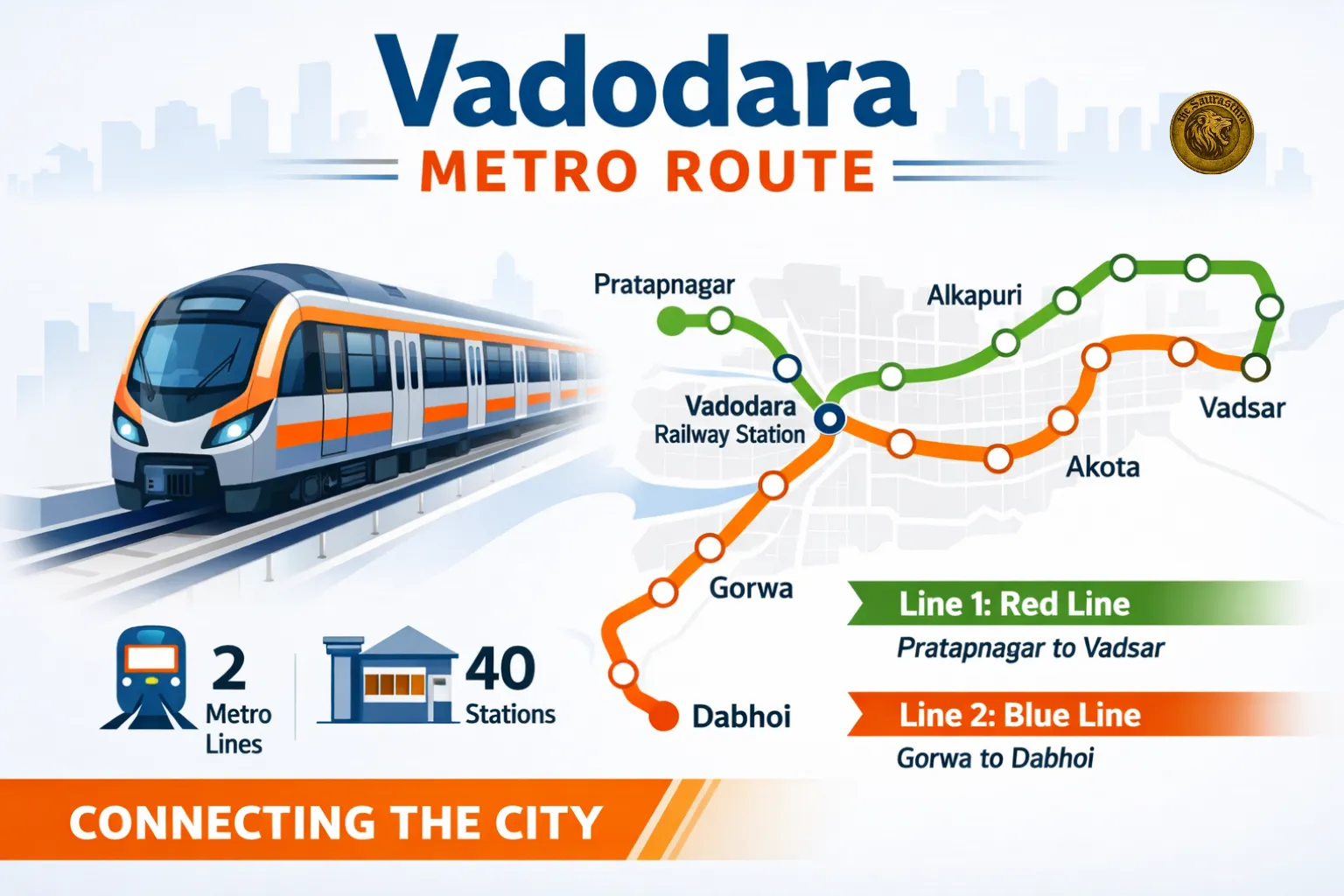
The Vadodara metro route has been carefully planned to connect key residential, industrial, commercial, and institutional zones, ensuring seamless mobility across the city. With two main corridors, an interchange station, and dozens of strategically placed stops, the project promises to significantly improve connectivity for lakhs of residents and visitors.
Overview of the Vadodara Metro Project
The Vadodara Metro network consists of two primary corridors known as the Blue Line and the Red Line. Together, these lines cover major parts of the city, linking the old city areas with new industrial hubs, business districts, educational institutions, and transport terminals. The system is expected to play a crucial role in supporting Vadodara’s urban expansion while offering a reliable, fast, and eco-friendly alternative to road transport.
In total, the metro system will feature:
- 19 stations on the Blue Line (South–North corridor)
- 17 stations on the Red Line (North–East corridor)
- 1 interchange station, enabling smooth transfers between the two lines
Blue Line: South–North Corridor
The Blue Line of the Vadodara metro route is designed to run from the southern parts of the city to the northern zones, passing through some of the most important commercial and residential areas. This corridor will connect industrial regions, business centers, educational institutions, and the airport, making it one of the most heavily used sections of the network.
Key areas served by the Blue Line include Makarpura, Manjalpur, Akota, Alkapuri, Sayajigunj, and Karelibaugh. The line also provides direct metro access to Vadodara Junction railway station and the airport, significantly improving last-mile connectivity for travelers.
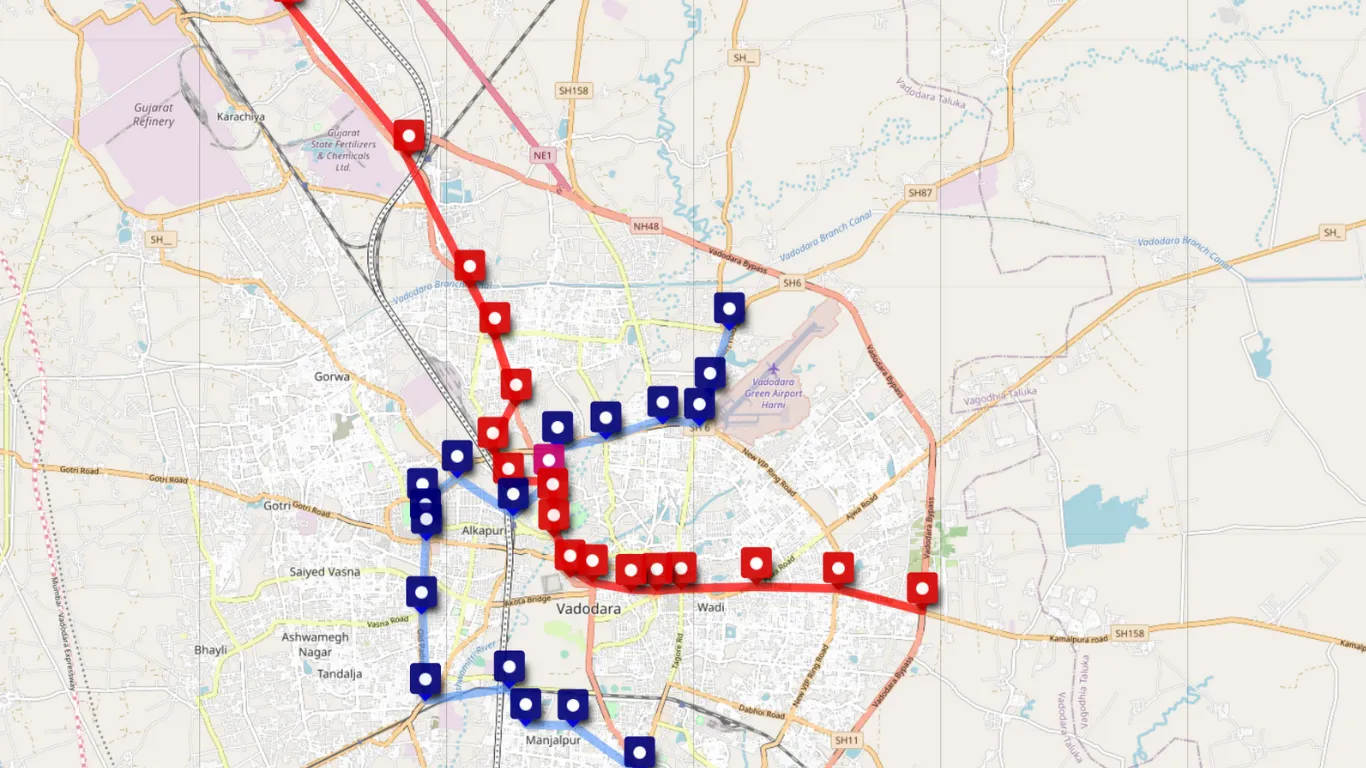
List of Blue Line Stations:
- Airport
- Akota Stadium
- Akshar Chowk
- Bhavans School
- Chakli Circle
- Fatehgunj
- Genda Circle
- Harni Lake
- Karelibaugh North
- Karelibaugh South
- Makarpura Bus Stand
- Makarpura Palace
- Manjalpur 1
- Manjalpur 2
- MSU (Maharaja Sayajirao University)
- RC Dutt Road
- Sussen Circle
- Trident Circle
- Vadodara Junction
- Vishwamitri
- VUDA
This corridor is expected to benefit office-goers, students, and industrial workers by offering fast and dependable transport across busy urban zones.
Red Line: North–East Corridor
The Red Line of the Vadodara metro route focuses on linking the historic old city with emerging industrial areas. It plays a vital role in connecting densely populated neighborhoods with employment hubs, government offices, and key transport infrastructure.
One of the most significant advantages of the Red Line is its connectivity to the railway station, the proposed bullet train station, and major industrial units such as GSFC and IOCL. This corridor will help ease congestion in narrow old-city roads while offering a modern alternative for daily commuters.
List of Red Line Stations:
- Ajwa
- Ajwa Bridge
- Bullet Train Station
- Chhani
- Dandiya Bazar
- GSFC
- IOCL
- Jail Road
- Kala Ghoda
- Mandvi Gate
- MSU
- Nizampura 1
- Nizampura 2
- Nyay Mandir
- Pandya Bridge
- Pani Gate
- Sayajibaugh
- Sur Sagar
These stations have been selected to ensure coverage of traditional markets, administrative zones, cultural landmarks, and industrial belts.
Interchange Station and Network Integration
A key feature of the Vadodara metro route is the interchange station at MSU, where both the Blue Line and Red Line intersect. This interchange will allow passengers to switch between corridors without exiting the system, reducing travel time and increasing convenience. The integration of the two lines ensures that commuters can travel across the city with minimal transfers.
System Specifications and Technology
The Vadodara Metro is being developed using modern metro rail standards and advanced technology to ensure safety, speed, and efficiency. The system specifications reflect global best practices in urban rail transport.
- Top Speed: 80 kmph
- Average Operational Speed: 33 kmph
- Track Gauge: Standard Gauge (1435 mm)
- Electrification: 750 V DC third rail system
- Signalling: Communication-Based Train Control (CBTC)
The CBTC signalling system will enable precise train control, reduced headways, and improved safety, allowing the metro to handle high passenger volumes during peak hours.
Impact on Vadodara’s Urban Development
The introduction of the Vadodara metro route is expected to have a transformative impact on the city’s economy and quality of life. Reduced travel times, lower pollution levels, and improved connectivity will encourage public transport usage and reduce dependence on private vehicles. The metro will also support transit-oriented development, leading to new commercial and residential projects around station areas.
Industrial corridors such as GSFC, IOCL, and GIDC will benefit from faster workforce mobility, while students and professionals will enjoy improved access to universities, offices, and business hubs.
Conclusion
The Vadodara Metro represents a major leap forward in the city’s infrastructure journey. With two well-planned corridors, extensive station coverage, advanced technology, and strong integration with existing transport systems, the Vadodara metro route is set to redefine urban mobility in central Gujarat. Once operational, it will not only make daily commuting smoother but also position Vadodara as a modern, well-connected, and future-ready city on India’s metro rail map.