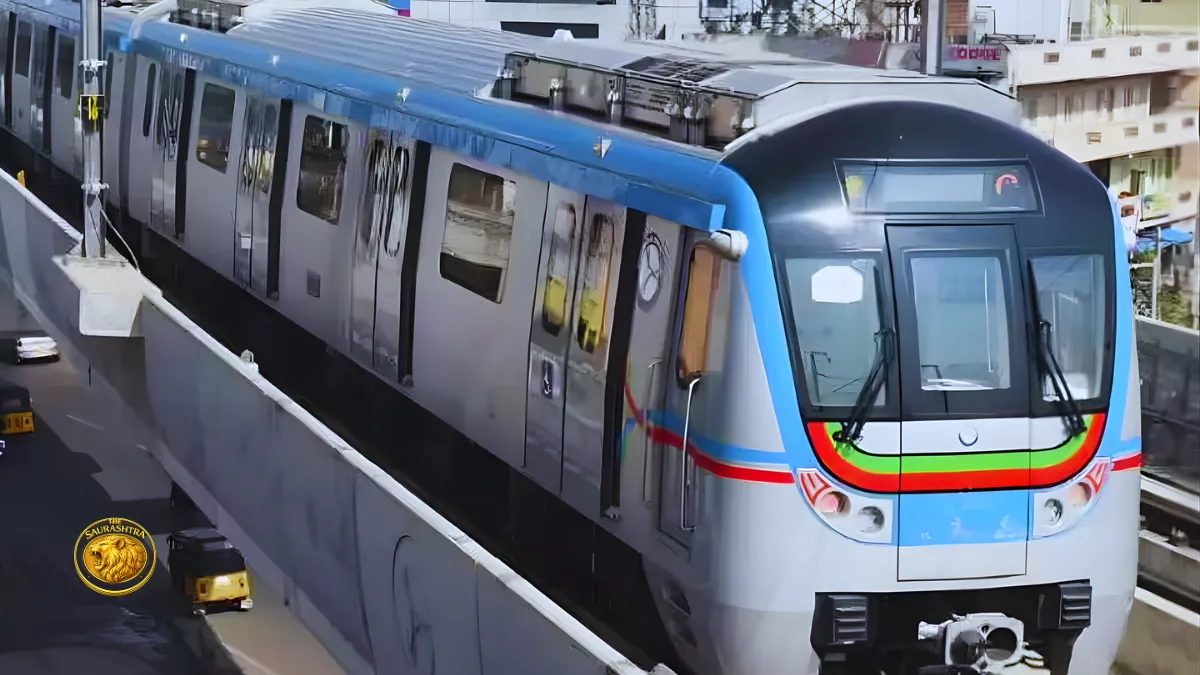
Surat Metro has taken a major step toward becoming a reality, bringing excitement and relief to millions of residents in one of India’s fastest-growing cities. After years of construction, delays, and anticipation, the first trial run of the metro train has officially begun on a key stretch, marking a historic moment for Surat’s public transportation system.
The initial trial is being conducted on an 8.5-kilometer elevated corridor between Dream City and Althan Tenement stations. This development indicates that the long-awaited Surat Metro project is now entering its final phase before full-scale operations begin.
Surat Metro Trial Run: A Milestone Moment
The successful completion of the viaduct between Dream City and Althan Tenement has paved the way for the trial runs. Authorities have confirmed that critical infrastructure such as track laying and third rail installation for traction power has already been completed.
The trial process is extensive and involves nearly 500 hours of train operations to ensure safety, efficiency, and performance under real conditions. During this phase, multiple inspections and certifications will be carried out by regulatory authorities, including:
- Research Designs and Standards Organisation (RDSO)
- Commissioner of Metro Rail Safety (CMRS)
This marks the beginning of a rigorous testing phase that will determine the readiness of Surat Metro for public use.
Construction Progress: Stations Near Completion
Significant progress has also been made on station infrastructure. Out of the planned stations on this stretch:
- Structural work of 7 metro stations has been completed
- Entry and exit structures are nearing completion
- Interior finishing and final touches are underway
This rapid progress suggests that the project is moving steadily toward operational readiness.
Political Buzz Around Surat Metro Launch
The timing of the Surat Metro trial run has sparked discussions in political circles. With local body elections expected soon, including elections for Surat Municipal Corporation and several other municipal bodies, some observers believe that the trial run may also carry political significance.
There is speculation that the ruling party aims to showcase the progress of Surat Metro as a major development achievement ahead of elections. However, regardless of political interpretations, the project itself remains a crucial infrastructure upgrade for the city.
Surat Metro Project Overview
The Surat Metro project was officially launched on January 18, 2021, and is being developed in phases across two major corridors covering a total length of 40.45 kilometers.
Key Corridors of Surat Metro
| Corridor Name | Route | Length |
|---|---|---|
| Diamond Corridor | Dream City to Sarthana | Part of total |
| Textile Corridor | Saroli to Bhesan | Part of total |
These corridors are strategically designed to connect major residential, commercial, and industrial areas of Surat.
Full Operations Expected by June 2026
According to officials, the Surat Metro is expected to become fully operational by June 2026. Residents, who have faced years of traffic congestion, road closures, and business disruptions due to construction, are eagerly awaiting the launch.
The project is expected to:
- Reduce traffic congestion
- Improve daily commuting
- Boost local businesses
- Enhance overall urban mobility
Citizens are hopeful that the announced timeline will be maintained without further delays.
Advanced Technology: Driverless Metro Trains
One of the standout features of Surat Metro is its modern and advanced technology. The trains will operate using a driverless train operation (DTO) system, ensuring high efficiency and safety.
Key Features of Surat Metro Trains
- 3-coach train configuration
- Maximum speed of 80 km/h
- Equipped with CCTV surveillance systems
- Advanced fire detection mechanisms
- Real-time monitoring systems
Additionally, the interiors of the metro coaches will reflect the cultural and industrial identity of Surat. Themes inspired by:
- Diamond industry
- Textile heritage
- Traditional Garba art
will be incorporated into the design, making the metro not just a transport system but also a representation of the city’s identity.
Fare Structure: Affordable Yet Flexible
The proposed fare structure of Surat Metro is designed to be affordable, especially for long-distance commuters. While initial estimates suggest fares may be slightly higher than Ahmedabad Metro, officials have indicated that the final pricing will depend on multiple factors such as operational costs and passenger demand.
Proposed Fare Structure of Surat Metro
| No. | Number of Stations | Distance (km) | Fare (₹) |
|---|---|---|---|
| 1 | 1 to 3 stations | 0 – 2 km | ₹10 |
| 2 | 4 to 6 stations | 2 – 5 km | ₹15 – ₹20 |
| 3 | 7 to 12 stations | 5 – 10 km | ₹25 |
| 4 | 13 to 20 stations | 10 – 18 km | ₹30 – ₹35 |
| 5 | 20+ stations | Above 18 km | ₹40 |
This pricing model aims to make metro travel a cost-effective alternative to auto-rickshaws and private vehicles.
Benefit for Long-Distance Travelers
The fare structure particularly benefits those traveling longer distances. For instance:
- Traveling across more than 20 stations will cost just ₹40
- Short-distance commuters will pay as little as ₹10
This makes Surat Metro a highly economical option for daily commuters across the city.
Surat Metro Routes and Stations
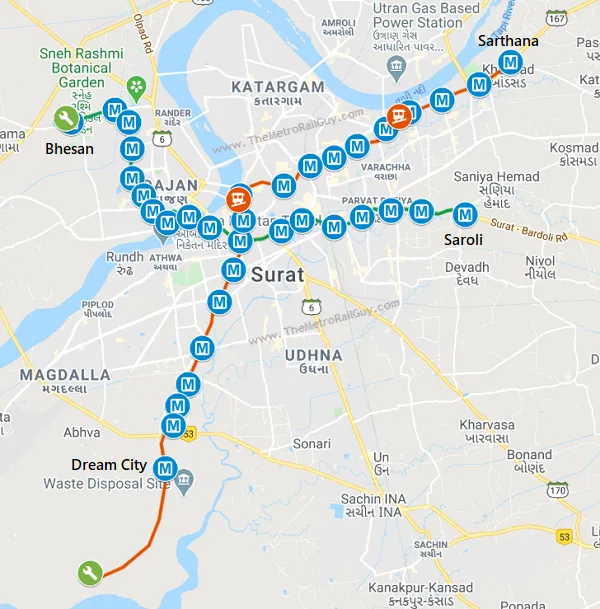
1. Sarthana to Bhesan Corridor (Textile Corridor)
Total Length: 19.26 km
Total Stations: 19
Type: Fully Elevated
Stations:
- Bhesan
- Botanical Garden
- Ugat Parishad
- Palanpur Road
- L.P. Savani School
- PVR Cinema Centre
- Adajan Gam
- Aquarium
- Badi Narayan Mandir
- Akshar Chowkdi
- Majura Gate (Interchange)
- Khatodara Darwaja
- Dindoli Darwaja
- Anjana Farm
- Model Town
- Magob
- Bharat Cancer Hospital
- Sarthana
2. Sarthana to Dream City Corridor (Diamond Corridor)
Total Length: 22.27 km
Total Stations: 21
- Elevated Route: 15.14 km
- Underground Route: 6.47 km
Underground Stations:
- Kapodra
- Laxmeshwar Chowk
- Central Warehouse
- Surat Railway Station
- Maskati Hospital
- Chowk Bazaar
Elevated Stations:
- Sarthana
- Nature Park
- Varachha Chowpati Garden
- Shree Swaminarayan Mandir (Kalakunj)
- Gandhibagh
- Kadarshah Naal
- Majura Gate (Interchange)
- Udhna Canal
- Althan Tenement
- Althan Gam
- VIP Road
- Mahila ITI
- Bhesan
- Convention Center
- Dream City
Impact of Surat Metro on City Life
The launch of Surat Metro is expected to transform urban living in multiple ways:
1. Traffic Decongestion
Surat has been struggling with heavy traffic due to rapid urbanization. Metro services will significantly reduce the number of private vehicles on roads.
2. Economic Growth
Improved connectivity will boost commercial activities and attract investments.
3. Environmental Benefits
Reduced vehicle emissions will contribute to cleaner air and a healthier environment.
4. Time Efficiency
Faster travel will save valuable time for daily commuters.
Challenges Faced During Construction
Over the past five years, the construction of Surat Metro has not been without challenges. Residents and businesses have faced:
- Traffic disruptions
- Road blockages
- Decline in business activities in affected areas
Despite these issues, the nearing completion of the project brings hope and relief to the citizens.
What Lies Ahead?
With trial runs now underway, the next steps include:
- Extensive safety testing
- Regulatory approvals
- Finalization of fare structure
- Staff training and operational setup
Once these steps are completed, Surat Metro will be ready for public launch.
Also read: Vadodara Metro Route: Full Details of Lines, Stations, Connectivity and System Features
Conclusion
The launch of the Surat Metro trial run marks a turning point in the city’s journey toward modern urban infrastructure. From easing traffic congestion to offering affordable and efficient transportation, the metro is set to redefine how Surat moves.
As the city awaits full operations by June 2026, the successful trial run between Dream City and Althan Tenement has already given residents a glimpse of a faster, smarter, and more connected future.
Surat is not just building a metro system—it is building the backbone of its future growth.