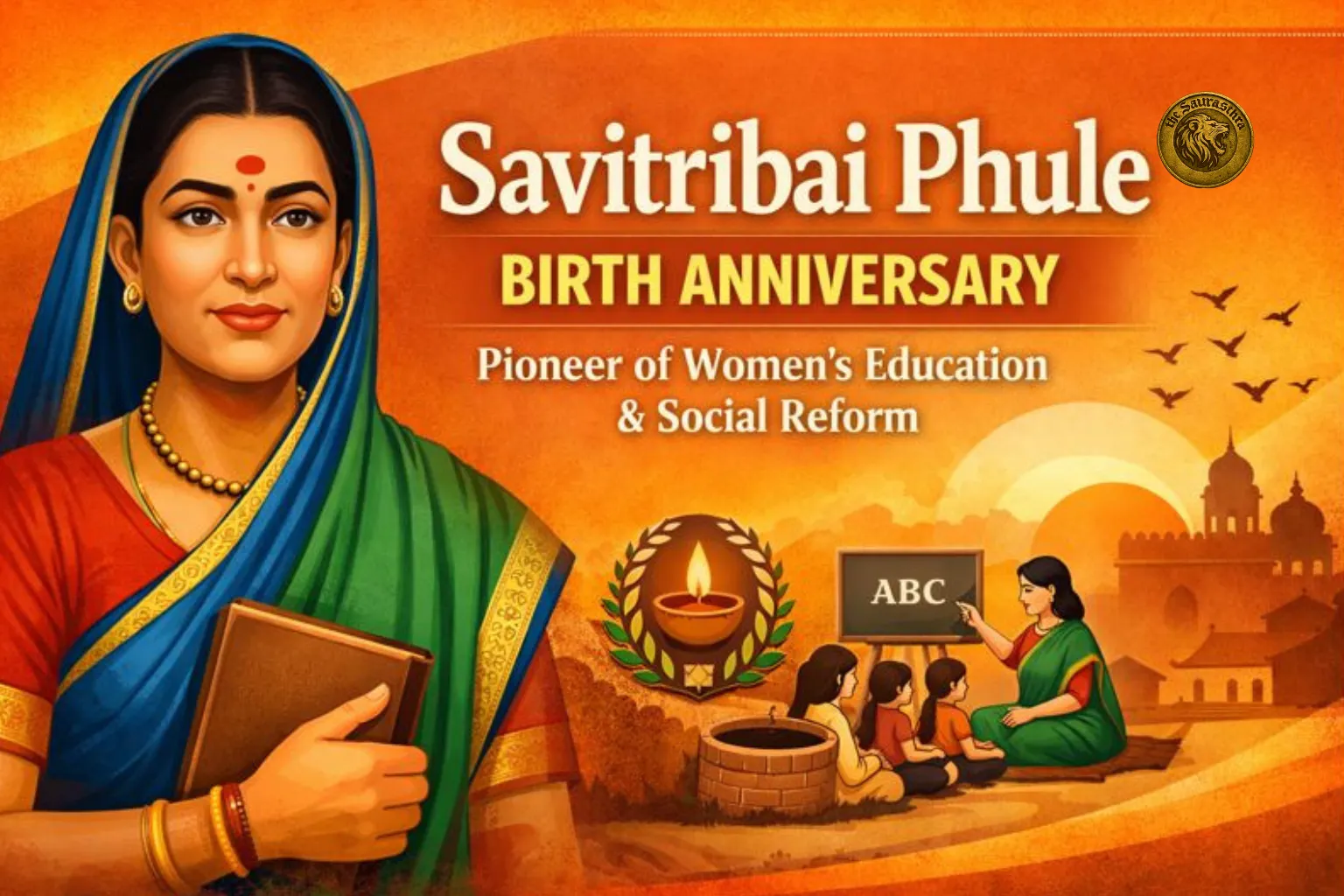
January 3 marks the Savitribai Phule birth anniversary, a day dedicated to honoring one of India’s most influential social reformers and pioneers in women’s education. Born in 1831 in the small village of Naigaon, in what is now Maharashtra, Savitribai Phule’s life was defined by her unwavering commitment to equality, education, and empowerment. She stands as a towering figure in India’s history, remembered for challenging social hierarchies and opening doors of opportunity for marginalized communities.
Early Life and Education
Savitribai Phule was married at the tender age of nine to Jyotirao Phule, a child at the time who would later become her lifelong partner in social reform. Relocating to Poona (present-day Pune), Savitribai was inspired by her husband’s commitment to education. Recognizing her thirst for knowledge, Jyotirao personally taught her to read and write. Her zeal for learning soon led her to train as a teacher at Christian missionary institutions in Ahmednagar and Poona, earning her teaching qualifications in 1847—making her one of the first female teachers in India.
Her early experiences of discrimination and social marginalization fueled her determination to use education as a tool to uplift the oppressed, particularly girls and women from lower-caste backgrounds.
Trailblazer in Education
In 1848, Savitribai and Jyotirao Phule opened their first school for girls in Bhidewada, Poona. The school welcomed six girls, marking the beginning of a revolutionary movement in women’s education. A year later, she started an adult education school, open to students of all castes, defying the rigid social norms of the era. Despite severe societal backlash, including verbal abuse and physical attacks on her way to school, Savitribai remained resolute. She even carried a spare sari to change into upon reaching the school after being pelted with stones, mud, and dung.
Her efforts faced resistance from orthodox communities. In 1849, her father-in-law asked her and Jyotirao to leave the family home for empowering lower-caste individuals, deemed a “sin” by prevailing social standards. Unfazed, Savitribai offered stipends to students to encourage attendance, ensuring education remained accessible. By 1851, the Phules were running three schools with over 150 girls enrolled, eventually establishing a total of 18 schools in the Poona region. Their commitment earned Savitribai recognition as the best teacher in the Bombay Presidency in 1852.
Advocacy for Women’s Rights and Social Equality
Savitribai Phule’s impact extended far beyond classrooms. She opened a shelter for widows in 1854 and expanded it in 1864 to accommodate destitute women and child brides abandoned by their families. She championed causes such as widow remarriage, education for women, and the eradication of child marriage, infanticide, and the practice of sati, which, although officially abolished in 1829, remained prevalent.
In a bold stand against caste discrimination, the Phules dug a well in their backyard, allowing lower-caste individuals access to water, challenging strict social taboos. In 1874, Savitribai adopted Yashwant Rao, the son of a Brahmin widow who had delivered the baby at her shelter, nurturing him to become a doctor—further highlighting her commitment to breaking societal barriers.
Role in Satyashodhak Samaj
Savitribai Phule was a central figure in the Satyashodhak Samaj, the reform society founded by her husband in 1873. The organization sought to dismantle caste-based inequality, unite lower-caste communities, and promote social justice through education and reform. Under Savitribai’s guidance, the society encouraged Satyashodhak marriages—weddings conducted without Brahmin priests and dowries, emphasizing equality, education, and social conscience.
Her work with the Samaj helped cultivate a culture of empowerment for women and marginalized communities, laying a foundation for modern social reform movements in India.
Read also: Jane Austen biography: The Quiet Life That Changed English Literature Forever
Later Life and Legacy
Jyotirao Phule passed away in 1890, and Savitribai courageously lit his funeral pyre, defying conventional norms that allowed only men to perform last rites. She continued her reform work until her death on March 10, 1897, succumbing to the bubonic plague she had fought to contain through her community clinics.
Savitribai Phule’s literary contributions include her poetry collections Kavya Phule (1854) and Bavan Kashi Subodh Ratnakar (1892), along with the publication of her husband’s speeches in 1856. Her legacy has been honored in various ways, including a commemorative postal stamp issued by India Post in 1998. In 2014, the University of Pune was renamed Savitribai Phule Pune University, cementing her enduring impact on education and society.
Read also: National Mathematics Day: Celebrating the Power of Numbers and the Legacy of Indian Mathematics
Commemorating the Savitribai Phule Birth Anniversary
Every year, the Savitribai Phule birth anniversary is observed across India, especially in Maharashtra, with ceremonies, educational programs, and discussions highlighting her pioneering work. Schools, universities, and social organizations pay tribute to her vision of a society free from caste and gender-based discrimination, inspiring generations to carry forward her mission.
Her life story remains a beacon of courage, resilience, and dedication. Savitribai Phule’s unwavering commitment to education, social justice, and women’s empowerment continues to resonate today, reminding the world of the transformative power of knowledge and equality.
Born: January 3, 1831, Naigaon, Maharashtra, India
Died: March 10, 1897, Poona (now Pune), India
Spouse: Jyotirao Phule