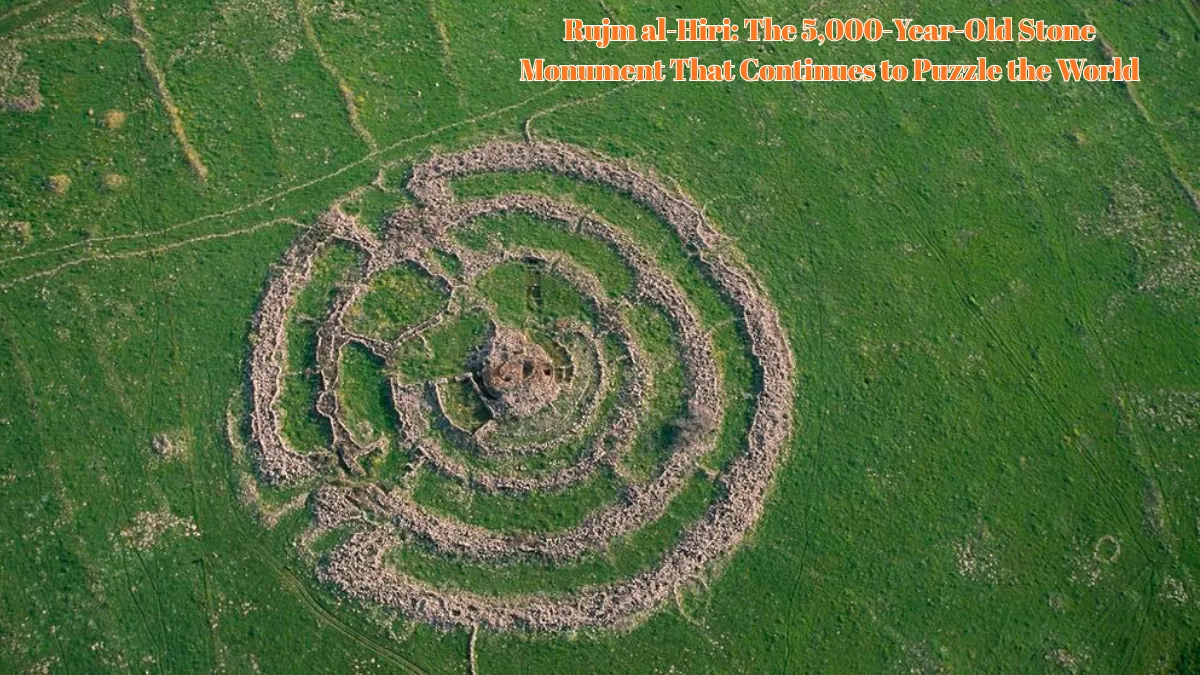
Hidden within the vast volcanic plains of the Golan Heights lies one of the Middle East’s most mysterious prehistoric landmarks. Known as Rujm al-Hiri, this ancient stone monument predates many famous archaeological sites and continues to intrigue historians, archaeologists, and researchers worldwide. Built more than 5,000 years ago, the massive basalt structure stands as a silent witness to a civilisation whose knowledge and purpose remain largely unknown.
Often compared to Stonehenge in England because of its age and enigmatic design, Rujm al-Hiri is considered one of the largest and most complex stone monuments in the region. Despite decades of research, its original function has never been definitively identified, adding to its enduring fascination.
An Ancient Structure Lost in Time
Archaeological evidence suggests that Rujm al-Hiri was constructed during the early Bronze Age, around the third millennium BCE. This places its origin at roughly the same time as Stonehenge in Europe, a comparison that has earned it the nickname “the Stonehenge of the Middle East.”
What makes Rujm al-Hiri especially remarkable is the sheer scale of its construction. The monument is built entirely from black basalt stones, sourced locally from the volcanic terrain of the Golan Heights. Researchers estimate that more than 40,000 tons of basalt were used to create the structure—an astonishing feat for a prehistoric society without modern machinery.
The site spans approximately 150 metres in diameter and dominates the surrounding landscape, making it visible from a considerable distance. Its size alone suggests that the people who built it possessed advanced organisational skills, labour coordination, and a deep understanding of stone construction.
A Labyrinth of Stone Circles
At the heart of Rujm al-Hiri lies a complex arrangement of four to five concentric stone circles, all centred around a large stone mound. When viewed from above, the layout resembles a vast labyrinth, carefully designed rather than randomly assembled.
The outermost circle is the largest, with stone walls standing up to two metres high in some places. Narrow passageways connect the rings, creating a winding path that appears deliberately planned. At the centre sits a stone cairn or mound, believed to have been added later than the outer circles, suggesting the monument evolved over time.
Unlike many ancient structures, Rujm al-Hiri was not built as a single-phase project. Archaeologists believe it was expanded or modified across generations, reinforcing the idea that the site held long-term significance for the people who used it.
What Was Rujm al-Hiri Used For?
Despite extensive study, the true purpose of Rujm al-Hiri remains one of archaeology’s great mysteries. Several theories have emerged over the years, each supported by compelling but incomplete evidence.
A Prehistoric Observatory
One of the most widely discussed theories is that Rujm al-Hiri functioned as an ancient astronomical observatory. Researchers have identified alignments within the stone walls that appear to correspond with significant celestial events, particularly the summer solstice.
Some of the narrow entrances and passageways seem to align precisely with the point where the sun rises on the longest day of the year. This has led scientists to believe that the builders possessed advanced knowledge of solar cycles and used the site to mark seasonal changes—an essential skill for agricultural societies.
A Ritual or Ceremonial Site
Another theory suggests that Rujm al-Hiri served as a religious or ceremonial centre. The monument’s circular design, central mound, and maze-like layout may have been intended for ritual processions or sacred gatherings.
The effort required to transport and position thousands of massive stones implies that the site held deep spiritual or cultural importance. Many prehistoric societies built monumental structures not for practical purposes, but to honour deities, ancestors, or cosmic forces.
A Burial Complex
Some archaeologists believe the central mound was used as a burial site, possibly for a high-status individual or a group of elites. Although human remains are scarce, this theory gains support from the fact that cairns were commonly used for funerary purposes in ancient cultures.
If Rujm al-Hiri did serve as a burial monument, the surrounding stone circles may have been designed to protect or sanctify the site, reinforcing its symbolic significance.
Names That Reflect Myth and Legend
The monument’s mystery is reflected even in its name. In Arabic, “Rujm al-Hiri” translates to “the heap of stones of the wild cat.” This poetic description likely stems from local folklore and imaginative interpretations passed down through generations.
In Jewish tradition, the site is known as Gilgal Refaim, a Hebrew term meaning “Circle of the Giants.” This name is rooted in ancient biblical legends that speak of a race of giants, adding a mythological dimension to the monument’s already enigmatic presence.
These contrasting names highlight how Rujm al-Hiri has inspired awe, curiosity, and storytelling across cultures for thousands of years.
One of the Middle East’s Largest Stone Monuments
Rujm al-Hiri stands out not only for its mystery but also for its scale. It is widely regarded as one of the largest prehistoric stone monuments in the Middle East, surpassing many better-known sites in both size and complexity.
Unlike monuments built in urban centres, Rujm al-Hiri is located in a remote, open landscape. This isolation raises further questions: Why was such a massive structure built far from major settlements? What drew people to this location?
Some experts suggest the site may have served as a regional gathering place, attracting communities from across the area for seasonal events, rituals, or astronomical observations.
Modern Research and Ongoing Exploration
Advances in technology have allowed researchers to study Rujm al-Hiri in new ways. Aerial photography, satellite imaging, and ground-penetrating radar have revealed hidden details of the site’s layout, confirming its precise geometric design.
Yet, despite these tools, many questions remain unanswered. The lack of written records from the time means researchers must rely on physical evidence and comparative studies, making definitive conclusions difficult.
What is clear, however, is that Rujm al-Hiri represents a level of sophistication often underestimated in prehistoric societies. Its builders demonstrated not only engineering skill but also a deep connection to their environment and the cosmos.
Read also: The British Museum: A Living Archive of Human Civilization
Why Rujm al-Hiri Still Matters Today
In an era dominated by modern technology, ancient sites like Rujm al-Hiri remind us that early human societies were far more advanced than often assumed. The monument challenges traditional narratives of prehistory and encourages a reevaluation of ancient knowledge systems.
For historians and archaeologists, Rujm al-Hiri is not just a relic of the past—it is an open question, a puzzle that continues to inspire research and debate. For the wider public, it is a symbol of humanity’s enduring desire to understand the world, mark time, and leave a lasting legacy.
Read also: Tipu Sultan Original Photo British Museum: History, Myths, and the Truth Behind the Image
A Monument That Defies Easy Explanation
More than 5,000 years after its construction, Rujm al-Hiri remains one of the world’s most intriguing archaeological enigmas. Whether it was an observatory, a sacred ritual site, a burial monument, or something entirely different, its purpose continues to elude certainty.
What cannot be disputed is its significance. Rising from the basalt plains, Rujm al-Hiri stands as a powerful testament to ancient ingenuity, belief, and ambition. As research continues, this remarkable stone monument may yet reveal new secrets—but for now, it remains a timeless mystery etched in stone.