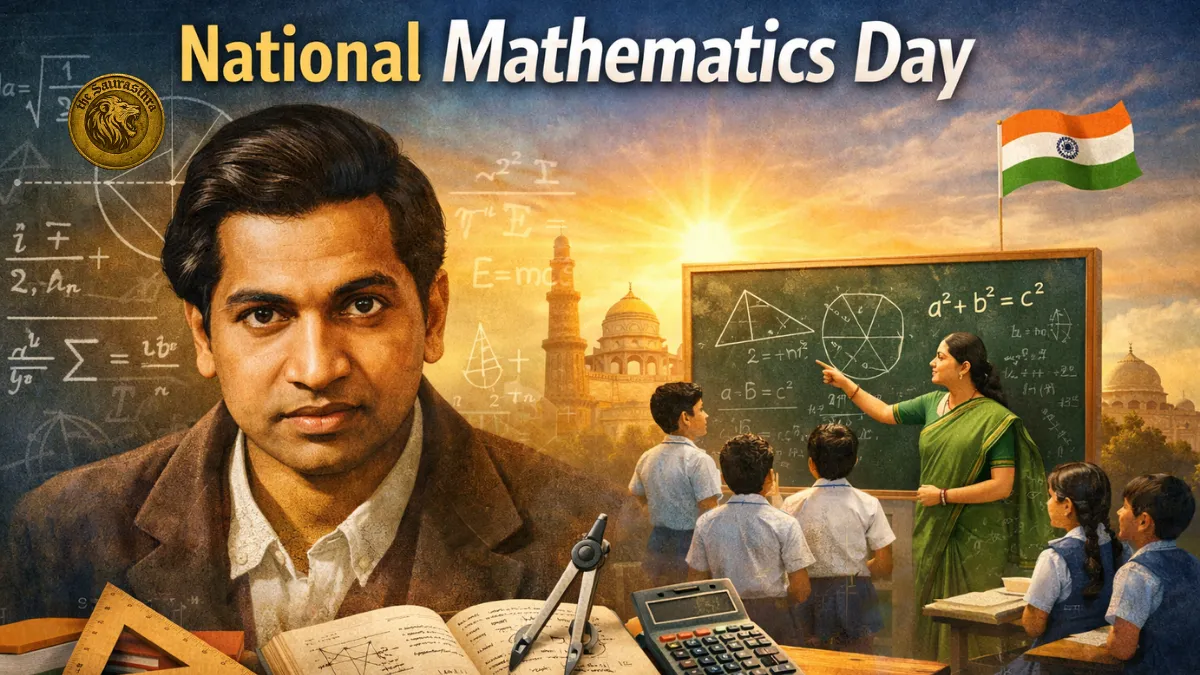
National Mathematics Day is observed in India as a tribute to the enduring importance of mathematics in human progress and as a celebration of one of the country’s greatest intellectual minds. National Mathematics Day is not merely a date on the calendar; it is an opportunity to reflect on how mathematical thinking shapes education, science, technology, economics, and everyday decision-making. From classrooms and research institutions to financial systems and digital innovation, mathematics quietly underpins modern life, making this observance both timely and essential.
Marked annually on December 22, National Mathematics Day commemorates the birth anniversary of Srinivasa Ramanujan, whose extraordinary contributions continue to influence global mathematics. The day is observed across schools, universities, and academic bodies with lectures, workshops, competitions, and discussions that aim to inspire curiosity and critical thinking among students and the general public alike.
The Origin and Purpose of National Mathematics Day
National Mathematics Day was officially declared by the Government of India in 2012 to honor the legacy of Srinivasa Ramanujan. The announcement marked the 125th birth anniversary of the mathematician, recognizing his profound impact on number theory, infinite series, and mathematical analysis. Since then, the observance has grown into a nationwide academic and educational initiative.
The core purpose of National Mathematics Day is to highlight the relevance of mathematics beyond textbooks and examinations. It seeks to promote problem-solving skills, logical reasoning, and analytical thinking, especially among young learners. By dedicating a national observance to mathematics, policymakers and educators aim to address math anxiety, encourage innovation, and nurture talent that can contribute to scientific and technological advancement.
Srinivasa Ramanujan and His Enduring Influence
Any discussion of National Mathematics Day is inseparable from the life and work of Srinivasa Ramanujan. Born in 1887 in Erode, Tamil Nadu, Ramanujan displayed an exceptional aptitude for numbers from an early age. Despite limited formal training and significant personal hardships, he developed original mathematical ideas that astonished the academic world.
His collaboration with British mathematician G. H. Hardy at the University of Cambridge led to groundbreaking work in number theory, partitions, continued fractions, and modular forms. Many of Ramanujan’s formulas, once considered abstract, have found applications in modern fields such as cryptography, computer science, and theoretical physics.
National Mathematics Day serves as a reminder that intellectual brilliance can emerge from unexpected places and that curiosity-driven learning has the power to transcend social and economic barriers.
Why Mathematics Deserves National Recognition
Mathematics is often perceived as difficult or intimidating, yet it forms the foundation of countless disciplines. National Mathematics Day challenges this perception by emphasizing the practical and creative dimensions of the subject.
Mathematical thinking sharpens the ability to analyze patterns, evaluate evidence, and approach complex problems systematically. In an era defined by data, algorithms, and artificial intelligence, these skills are increasingly valuable. From managing public infrastructure to modeling climate change, mathematics enables informed decision-making at every level of society.
By celebrating National Mathematics Day, India acknowledges the subject’s role in national development and global competitiveness, reinforcing the idea that mathematical literacy is a public good.
How National Mathematics Day Is Observed Across India
Each year, National Mathematics Day is marked by a wide range of academic and educational activities. Schools organize quiz competitions, math fairs, and interactive workshops designed to make learning engaging rather than intimidating. Universities host seminars, public lectures, and panel discussions that explore both theoretical advances and real-world applications of mathematics.
Research institutions often use the occasion to highlight ongoing projects, encourage interdisciplinary collaboration, and recognize outstanding contributions by mathematicians and educators. Media outlets and educational platforms publish special features that bring mathematical concepts closer to a general audience.
While the scale of observance may vary, the underlying goal remains consistent: to foster a culture that values curiosity, reasoning, and lifelong learning.
National Mathematics Day in the Classroom
For educators, National Mathematics Day offers an opportunity to rethink how mathematics is taught and experienced. Traditional methods that rely heavily on rote memorization can be supplemented with activities that emphasize exploration and understanding.
Teachers often use the day to introduce historical anecdotes, puzzles, and real-life applications that demonstrate the relevance of mathematical concepts. Discussing the life of Srinivasa Ramanujan, for instance, helps students see mathematics as a human endeavor shaped by imagination and perseverance.
Such approaches can help reduce fear and resistance toward the subject, encouraging students to view mathematics as a tool for discovery rather than a source of stress.
Mathematics and Its Role in Modern Society
The relevance of mathematics extends far beyond academic settings. Financial markets rely on mathematical models to assess risk and forecast trends. Engineering and architecture depend on precise calculations to ensure safety and efficiency. Medical research uses statistical analysis to evaluate treatments and understand disease patterns.
National Mathematics Day draws attention to these connections, reminding the public that mathematical literacy is essential for informed citizenship. In a world increasingly driven by technology, understanding basic mathematical principles helps individuals navigate issues ranging from personal finance to digital security.
Encouraging Young Minds Through National Mathematics Day
One of the most important objectives of National Mathematics Day is to inspire young people to engage with mathematics in meaningful ways. Early exposure to problem-solving and logical reasoning can shape academic and career choices, opening pathways to fields such as science, engineering, economics, and data analysis.
Competitions and hands-on activities organized on this day aim to transform learning into an interactive experience. When students see mathematics as a creative and dynamic discipline, they are more likely to pursue it with confidence and curiosity.
This focus on youth is particularly significant for a country with a large and diverse student population, where nurturing talent can have long-term social and economic benefits.
Key Facts About National Mathematics Day
| Aspect | Details |
|---|---|
| Observed On | December 22 |
| First Declared | 2012 |
| Honored Figure | Srinivasa Ramanujan |
| Primary Objective | Promote awareness and interest in mathematics |
| Major Activities | Lectures, workshops, competitions, seminars |
| Scope | Schools, universities, research institutions across India |
The Global Context of Mathematical Celebration
While National Mathematics Day is specific to India, the idea of celebrating mathematics has global resonance. International initiatives such as World Mathematics Day and Pi Day reflect a shared recognition of the subject’s universal importance.
India’s observance stands out because of its focus on Ramanujan’s legacy, which bridges local history and global scholarship. By celebrating National Mathematics Day, India contributes to a broader international conversation about the value of mathematical thinking in addressing complex global challenges.
Challenges in Mathematics Education
Despite the significance of National Mathematics Day, challenges remain in making mathematics accessible and engaging for all learners. Unequal access to quality education, language barriers, and exam-oriented teaching methods can limit students’ understanding and appreciation of the subject.
Addressing these issues requires sustained effort beyond a single day of observance. However, National Mathematics Day provides a focal point for dialogue, innovation, and policy discussion aimed at improving mathematics education nationwide.
By encouraging experimentation with teaching methods and greater collaboration between educators and researchers, the day can act as a catalyst for long-term change.
Read also: Monkey Day? Understanding the Global Celebration of One of Nature’s Most Fascinating Creatures
The Future Vision of National Mathematics Day
As India continues to position itself as a knowledge-driven economy, the importance of mathematics will only grow. National Mathematics Day has the potential to evolve into a platform that not only celebrates past achievements but also shapes future priorities.
Integrating technology into mathematics education, promoting interdisciplinary research, and supporting young innovators are all directions that can be strengthened through this observance. By linking tradition with innovation, National Mathematics Day can remain relevant to changing educational and societal needs.
Read also: International Mountain Day: Understanding the Significance of the World’s High Altitudes
Conclusion: More Than a Commemoration
National Mathematics Day is more than a tribute to a legendary mathematician; it is a reminder of the enduring power of numbers to explain, predict, and transform the world. By celebrating National Mathematics Day, India affirms its commitment to intellectual curiosity, educational excellence, and scientific progress.
From honoring the genius of Srinivasa Ramanujan to inspiring the next generation of thinkers, National Mathematics Day underscores a simple yet profound truth: mathematics is not just a subject to be studied, but a language through which humanity understands the universe.