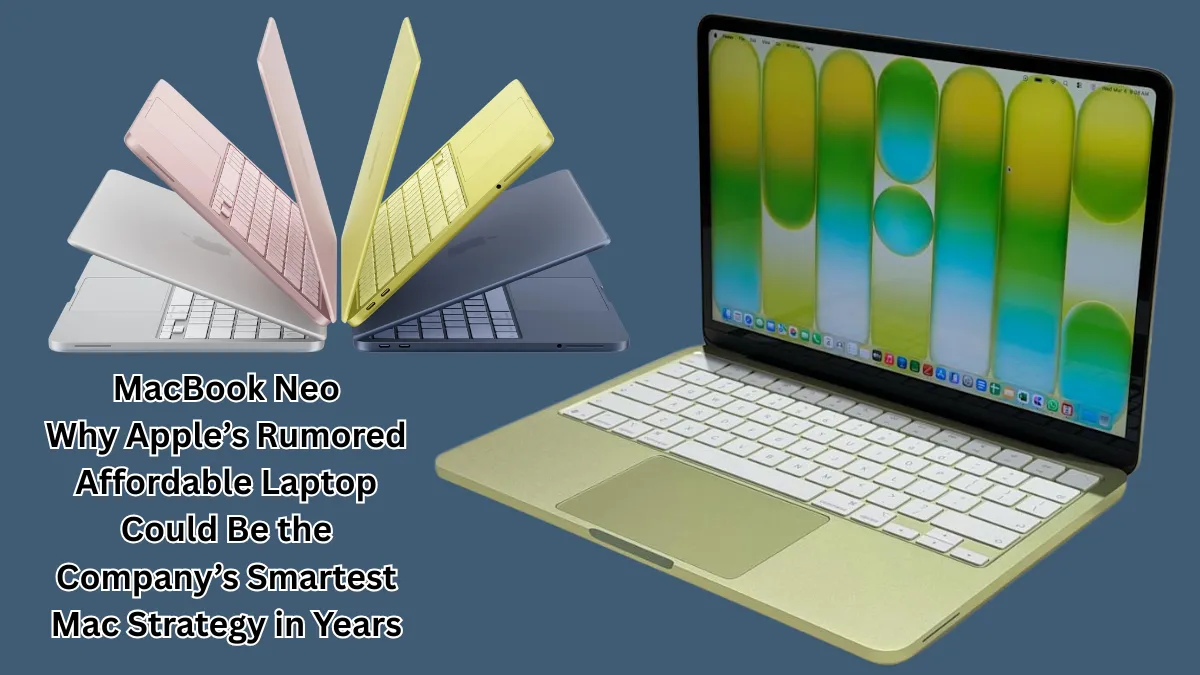
MacBook Neo: Apple rarely leaves visible gaps in its product lineup. Over the years, the company has built a reputation for carefully structuring its devices so that each model serves a distinct purpose. From iPhones to iPads and Apple Watches, the product ladder is usually well balanced. Yet for years, the MacBook lineup has had a surprisingly obvious hole.
The introduction of the macbook neo could finally change that.
For a long time, Apple’s laptop offerings have been divided into two clear categories: the MacBook Air and the MacBook Pro. While this approach may appear simple and streamlined on the surface, it leaves out a major group of users who want something in between — a reliable everyday laptop that doesn’t require paying for power they may never actually use.
If Apple launches the macbook neo as many analysts expect, it could represent one of the company’s most strategic Mac moves in years. More importantly, it could reshape how millions of people enter the Apple ecosystem.
The Missing Middle in Apple’s Laptop Lineup
Apple has always been known for precise product segmentation. The company typically creates clear steps in its product families so customers can easily decide which device best fits their needs.
But in the MacBook world, the structure has been unusually binary.
Consumers today essentially face two choices:
| Apple Laptop Category | Target User | Key Characteristics |
|---|---|---|
| MacBook Air | General users, students, professionals | Thin, powerful, portable |
| MacBook Pro | Creators and professionals | High performance, advanced hardware |
At first glance, this seems logical. However, the reality is more complicated.
The MacBook Air has become significantly more powerful over time. With Apple Silicon chips like the M1, M2, and M3, the Air is capable of handling demanding creative software, multitasking workloads, and even light video editing.
In other words, it is no longer simply an entry-level laptop.
Meanwhile, the MacBook Pro is designed for heavy-duty tasks such as professional video editing, coding, rendering, and complex development workflows.
This leaves a noticeable gap in Apple’s product ladder.
Many everyday users don’t need the power of a MacBook Air’s advanced performance, and they certainly don’t require a MacBook Pro. Yet they still want a Mac.
That is precisely where the macbook neo could fit.
What the MacBook Neo Could Represent
Rather than replacing the MacBook Air or competing directly with it, the macbook neo would likely serve a different purpose: restoring balance to Apple’s laptop lineup.
The idea is simple.
The macbook neo would target:
- Students
- Families
- Casual home users
- First-time Mac buyers
- People switching from Windows laptops
These users typically want a device that is:
- Reliable
- Affordable
- Easy to use
- Long-lasting
They don’t necessarily need professional-level hardware. What they need is a dependable everyday computer.
For years, Apple quietly stepped away from this segment. The original MacBook lineup, which once filled that role, disappeared from the company’s catalog.
The macbook neo could bring that concept back, but updated for the modern Apple ecosystem.
Apple’s Lost Entry-Level Advantage
Across the global PC industry, the entry-level laptop market is massive. Walk into almost any electronics store and you’ll see rows of budget laptops designed specifically for students and everyday users.
These devices dominate the lower price ranges.
Major categories include:
| Laptop Type | Typical Audience | Price Range |
|---|---|---|
| Budget Windows laptops | Students, home users | Low to mid-range |
| Chromebooks | Education market | Very affordable |
| Mid-range Windows PCs | Office work and general use | Mid-tier pricing |
These machines rarely focus on extreme performance. Instead, they prioritize accessibility and affordability.
For years, Apple largely avoided competing directly in this space.
Occasional discounts on the MacBook Air sometimes make it more affordable, but structurally, there is no clearly defined entry-level MacBook.
This absence has allowed Windows manufacturers and Chromebook makers to dominate the lower price segments.
The macbook neo could change that dynamic significantly.
Why Entry-Level Products Matter for Apple
Apple understands better than most companies the importance of having an accessible entry point into its ecosystem.
Consider the company’s most popular products.
| Apple Product Category | Entry Model | Premium Model |
|---|---|---|
| iPhone | Standard iPhone | iPhone Pro |
| Apple Watch | Apple Watch Series | Apple Watch Ultra |
| iPad | iPad | iPad Pro |
In nearly every category, the entry-level device drives the highest sales volume.
The premium models generate excitement and higher profit margins, but the mainstream versions bring millions of new users into Apple’s ecosystem.
A more affordable MacBook would follow the same strategy.
The macbook neo could become the gateway to macOS for an entirely new audience.
Ecosystem Gravity: Apple’s Biggest Advantage
One of Apple’s most powerful strengths isn’t just hardware. It’s the ecosystem.
Once someone owns one Apple device, they are far more likely to buy another.
This phenomenon is often described as ecosystem gravity.
Apple products work together in ways that create convenience — and subtle incentives to stay within the ecosystem.
Some of the most popular ecosystem features include:
| Feature | What It Does |
|---|---|
| AirDrop | Instantly share files between Apple devices |
| iMessage | Seamless messaging across iPhone, iPad, and Mac |
| iCloud Drive | Automatic file syncing |
| Universal Clipboard | Copy on one device, paste on another |
| Handoff | Continue tasks across devices |
These features make switching away from Apple less appealing once users are invested.
A lower-priced MacBook could dramatically expand the number of people entering that ecosystem.
The Typical Apple Ecosystem Journey
For many users, the journey into Apple’s ecosystem follows a familiar pattern.
It often starts with the iPhone.
Then over time, additional devices are added.
| Step | Device Purchased |
|---|---|
| Step 1 | iPhone |
| Step 2 | AirPods |
| Step 3 | iPad |
| Step 4 | Apple Watch |
| Step 5 | Mac |
For millions of users, the Mac is the final piece of the puzzle.
However, if Mac laptops feel too expensive, many people simply remain on Windows computers.
The macbook neo could remove that barrier.
Perfect Timing in the PC Market
The potential arrival of the macbook neo also comes at a moment when many Windows users are feeling uncertain about their platform.
The transition to Windows 11 has not been universally smooth.
Some common complaints include:
- Interface changes that users find confusing
- Higher system requirements
- Performance inconsistencies on older hardware
- Forced updates and hardware compatibility issues
Even Microsoft has acknowledged areas that need improvement.
This dissatisfaction creates an opportunity.
When users feel friction within one ecosystem, they become more open to alternatives.
If Apple introduces a visually appealing, affordable MacBook at the right moment, it could attract users who might otherwise never consider switching platforms.
Pricing: The Most Critical Factor
Of course, the success of the macbook neo would ultimately depend on pricing.
Reports suggest a potential price around ₹69,900 in India, which roughly translates to an affordable mid-range laptop category.
Here is what that pricing could mean strategically:
| Price Range | Market Position |
|---|---|
| Below ₹50,000 | Budget Windows laptops |
| ₹50,000 – ₹60,000 | Mid-range Windows laptops |
| Around ₹69,900 | Potential macbook neo price |
| ₹90,000+ | MacBook Air |
At first glance, ₹69,900 may not seem cheap.
But retail promotions, education discounts, and seasonal sales could push the price closer to ₹60,000 or lower.
At that level, the psychological shift is significant.
A MacBook would no longer feel like an unattainable luxury for many buyers.
Instead, it becomes a realistic alternative to mid-range Windows laptops.
A MacBook for Students and Families
A large portion of the global laptop market consists of devices purchased for education.
Parents buying laptops for children often prioritize:
- Reliability
- Long battery life
- Security
- Ease of use
Apple already excels in these areas.
If the macbook neo delivers Apple’s usual build quality and software stability at a lower price, it could quickly become a favorite among students and families.
Schools and universities might also consider adopting it more widely.
Design Matters More Than People Admit
There is another factor that often influences buying decisions: design.
Many consumers claim they only care about specifications. In reality, aesthetics play a huge role in purchasing choices.
Apple has historically excelled at combining technology with design personality.
Some iconic examples include:
- The colorful iMac G3
- The vibrant iPhone 5c
- The playful iPad colors
- Multiple Apple Watch finishes
The macbook neo could follow the same philosophy.
Rumors suggest that the laptop might feature bold color options, giving it a more approachable and personal feel.
If Apple introduces colors beyond the traditional silver and gray tones, it could appeal strongly to younger buyers.
Design can make a device feel less like a tool and more like a personal object.
That emotional connection matters.
Performance Expectations for MacBook Neo
Even as a lower-cost device, the macbook neo would still likely offer solid performance.
Apple’s custom silicon chips have dramatically improved efficiency and speed across its laptop lineup.
Possible hardware expectations might include:
| Feature | Expected Specification |
|---|---|
| Processor | Apple Silicon chip |
| Storage | SSD storage |
| Battery Life | All-day battery |
| Display | Retina display |
| Operating System | macOS |
Even a modest Apple chip would likely outperform many budget Windows laptops in real-world tasks.
For everyday computing, that performance would be more than sufficient.
Expanding the macOS User Base
From Apple’s perspective, the macbook neo could dramatically widen the funnel into macOS.
Right now, many potential Mac buyers simply never make the jump because of price.
By introducing a more accessible option, Apple could:
- Increase Mac market share
- Convert Windows users
- Strengthen ecosystem loyalty
- Grow software and services revenue
It would also make the Mac platform more visible to younger generations.
Students who start using macOS early are more likely to remain loyal users later in life.
Also read: Google Pixel 10a Price Revealed as Google Launches Pixel 10a With 5,100mAh Battery and 120Hz Display
A Long-Term Strategy, Not a Quick Win
If Apple launches the macbook neo, the impact likely won’t be immediate or explosive.
Instead, it would unfold gradually.
Each year, more students, families, and first-time Mac buyers would enter the ecosystem.
Over time, those users may upgrade to higher-end Apple devices.
That slow but steady expansion is exactly the kind of strategy Apple tends to execute extremely well.
Also read: Best Cameras in USA 2025: Top DSLR, Mirrorless & Vlogging Picks for Every Creator
Why the MacBook Neo Could Be a Game-Changer
The absence of a true entry-level Mac has been noticeable for years.
It has limited Apple’s reach in the broader laptop market and forced the company to rely heavily on higher-priced devices.
The macbook neo could change that dynamic entirely.
By offering:
- A more approachable price
- Friendly design
- Reliable performance
- Seamless ecosystem integration
Apple could make macOS accessible to millions of new users.
Also read: microsoft windows 11 emergency update After Outlook Crashes Disrupt Users Worldwide
Conclusion:
Not everyone needs professional-level performance.
But many people want the reliability, simplicity, and polish that Apple computers offer.
If Apple executes the macbook neo strategy correctly, it could become one of the company’s most important Mac launches in years.
It would open the door for new users, strengthen Apple’s ecosystem, and give the Mac lineup the balance it has been missing.
And in typical Apple fashion, the real impact would not appear overnight.
It would grow slowly — quietly — and then become impossible to ignore.