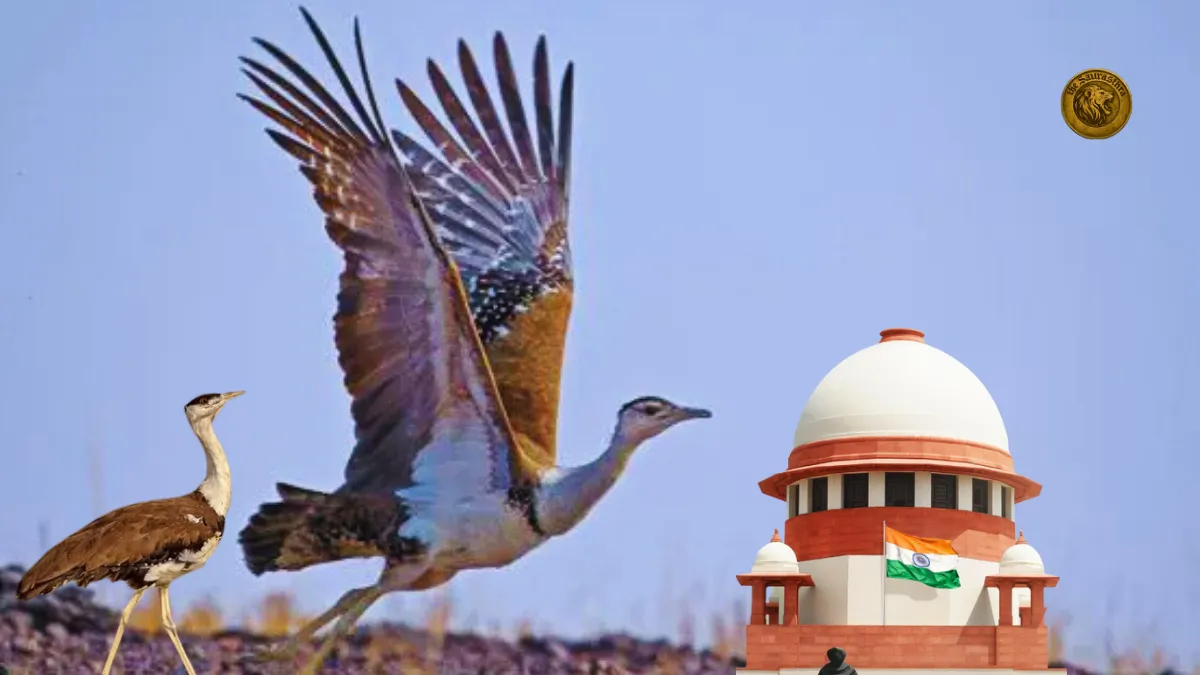
Great Indian bustard: In one of the most significant environmental rulings in India’s judicial history, the Supreme Court has delivered a landmark verdict aimed at protecting the critically endangered Great Indian bustard, a rare desert bird often described as the “jewel of the Thar Desert.” The ruling places strict restrictions on renewable energy infrastructure, including solar power parks, wind turbines, and overhead high-tension power lines, across a vast stretch of land spanning 14,753 square kilometres in Gujarat and Rajasthan.
The judgment, delivered by a bench comprising Justice P. S. Narasimha and Justice Atul Chandurkar, marks a decisive moment in the long-running legal battle between conservationists and large renewable energy developers. It prioritises wildlife protection in ecologically sensitive desert regions where the Great Indian bustard still survives, albeit in dangerously low numbers.
The Great Indian Bustard: A Species on the Brink
The Great Indian bustard (Ardeotis nigriceps) is one of the heaviest flying birds in the world and is endemic to India. Found primarily in the arid and semi-arid grasslands of Rajasthan’s Thar Desert and parts of Gujarat’s Kutch region, the bird is known locally as Godawan in Rajasthan and Ghorad in Gujarat. Revered by desert communities, it has long been called the “pearl of the desert” for its majestic appearance and ecological significance.
Despite standing over three feet tall and weighing up to 18 kilograms, the Great Indian bustard possesses remarkable flying ability. However, its survival is threatened by a fatal biological limitation: the structure of its eyes makes it difficult to detect power lines while flying. As a result, collisions with overhead electricity cables have become one of the leading causes of death for the species.
Today, fewer than 150 Great Indian bustards are believed to remain in the wild, placing the bird firmly on the brink of extinction.
The Legal Battle That Led to the Verdict
Concerned by the rapid expansion of solar parks, wind farms, and high-voltage transmission lines in desert habitats, former IAS officer M. K. Ranjitsinh, one of the principal architects of India’s Wildlife Protection Act, approached the Supreme Court in 2019. He was joined by conservationists and wildlife organisations alarmed by the rising number of bustard deaths caused by aerial collisions with power infrastructure.
Their petition highlighted how large-scale renewable energy projects, though essential for combating climate change, were being developed without sufficient safeguards for wildlife, particularly the Great Indian bustard.
The court appointed expert committees, including specialists from the Wildlife Institute of India (WII), to scientifically assess the impact of energy infrastructure on the bird’s habitat and survival.
Supreme Court Identifies Priority Conservation Zones
Based on expert recommendations, the Supreme Court has now designated specific priority areas where the Great Indian bustard still resides and breeds. These areas are to receive the highest level of protection.
Rajasthan: 14,013 Square Kilometres Declared Priority Area
In Rajasthan, the court has identified 14,013 square kilometres as critical habitat for the Great Indian bustard. These areas include:
- Desert National Park
- Pokhran Field Firing Range (PFFR)
- Ramdevra region
- Salkha-Kuchri grasslands
- Sanu-Mokla-Parewar belt
- Dholiya, Khetolai, Chacha, Odhaniya and surrounding villages
These regions form the last stronghold of the species and are now subject to strict infrastructure controls.
Gujarat: 740 Square Kilometres in Kutch Protected
In Gujarat, 740 square kilometres covering the Naliya grasslands of Kutch and nearby sensitive zones have been declared priority conservation areas. These grasslands are among the few remaining habitats suitable for the bird’s survival in the state.
Ban on New Solar Parks and Wind Turbines
The Supreme Court has imposed a complete ban on:
- New solar power parks above 2 megawatts
- New wind turbine installations
- Expansion of renewable energy infrastructure in priority bustard habitats
However, the court has allowed limited exemptions for small-scale projects under 2 MW, strictly meant to meet local energy needs without endangering wildlife.
This ruling effectively prevents large commercial renewable energy projects from entering these sensitive zones, reshaping future energy planning in desert regions.
Undergrounding Power Lines: A Two-Year Deadline
One of the most impactful directives in the judgment concerns existing power lines.
The court has ordered that 250 kilometres of high-risk overhead power lines, identified by the Wildlife Institute of India, must be undergrounded within two years.
Key directives include:
- Immediate undergrounding or rerouting of 33 kV power lines
- 80 km of such lines in Rajasthan
- 79.2 km in Gujarat
- Mandatory bird diverters only as a temporary measure where undergrounding is not immediately feasible
The court has made it clear that technical or financial challenges cannot be used as excuses to delay compliance.
Special Power Corridor Approved
Balancing environmental protection with energy needs, the Supreme Court has approved the creation of a dedicated power corridor.
- A 5-kilometre-wide corridor south of Desert National Park
- All future transmission lines must pass through this corridor
- Designed to minimise habitat fragmentation and reduce bird mortality
This move aims to streamline infrastructure development while protecting critical wildlife zones.
Gujarat-Specific Measures: “Jump Start” Conservation Plan
Recognising the fragile bustard population in Gujarat, the court has endorsed a special “Jump Start” conservation programme. Under this plan:
- Fertile eggs from Rajasthan may be brought to Gujarat
- Controlled breeding initiatives will be launched
- GPS tagging of birds will help track movement and threats
- Enhanced habitat management will be undertaken
These steps are intended to rebuild a viable bustard population in Gujarat over time.
Redefining Corporate Social Responsibility (CSR)
In one of the most striking aspects of the verdict, the Supreme Court has significantly expanded the definition of Corporate Social Responsibility (CSR).
In paragraph 38 of the judgment, the court stated that:
- Environmental protection is not charity but a constitutional obligation
- Article 51A(g) of the Indian Constitution mandates protection of wildlife and nature
- Companies cannot limit CSR to social donations alone
- Environmental responsibility is an integral part of CSR
The court emphasised that corporations operating in wildlife habitats are guests, not owners, and must allocate CSR funds toward conservation efforts.
Polluter Pays Principle Reinforced
The Supreme Court strongly reaffirmed the Polluter Pays Principle, ruling that:
- Companies whose projects harm wildlife or ecosystems must bear the cost of mitigation
- Renewable energy developers are not exempt from environmental accountability
- Conservation costs cannot be transferred to the public or the government
Solar power firms such as JSW and ACME, which were parties in the case, argued that restrictions would affect India’s green energy targets. However, the court ruled that climate goals cannot come at the cost of species extinction.
Revisiting the 2021 Blanket Ban
In 2021, the Supreme Court had issued an interim blanket ban covering nearly 99,000 square kilometres, halting overhead power lines across a vast region. Renewable energy companies challenged this order, calling it impractical and technically unworkable.
After detailed scientific evaluation, the court revised the order, narrowing restrictions to 14,753 square kilometres identified as high-priority bustard habitats. This revision reflects an effort to strike a balance between renewable energy development and wildlife conservation.
Why Power Lines Are Deadly for the Great Indian Bustard
The court acknowledged that despite its size, the Great Indian bustard is particularly vulnerable to aerial collisions.
- The bird’s forward vision is limited
- It cannot easily detect thin overhead wires
- Collisions often result in instant death
The court also recognised the bird’s cultural importance, especially among the Bishnoi community, which considers the species sacred and has historically protected wildlife in desert regions.
Conservationists Call It a Historic Victory
Reacting to the verdict, M. K. Ranjitsinh described it as a “historic win” for wildlife conservation in India.
“This has been a long and exhausting battle,” he said. “For years, we fought to ensure that the Great Indian bustard does not disappear forever. This judgment proves that development and conservation can coexist when guided by science and responsibility.”
Environmentalists believe the ruling could serve as a global precedent for balancing renewable energy expansion with biodiversity protection.
Also read: Zoo Vantara India: A Comprehensive Exploration of India’s Evolving Wildlife Haven
What the Verdict Means for the Future
The Supreme Court’s decision sets a powerful legal precedent with far-reaching implications:
- Renewable energy projects must integrate wildlife safeguards
- Environmental impact assessments will face greater scrutiny
- CSR obligations now explicitly include biodiversity conservation
- Courts may intervene more actively to protect endangered species
For the Great Indian bustard, the ruling offers a rare glimmer of hope. While challenges remain, experts believe the judgment significantly improves the bird’s chances of survival.
Also read: The Vantara Story: Transforming Compassion Into a New Era of Wildlife Conservation
Conclusion: A Turning Point for the Great Indian Bustard
The Supreme Court’s historic verdict represents a defining moment in India’s environmental jurisprudence. By placing the survival of the Great Indian bustard at the centre of policy decisions, the court has reaffirmed that progress cannot be measured solely in megawatts and profits.
As India pursues its renewable energy ambitions, this ruling sends a clear message: sustainable development must protect not only the planet’s climate but also its most vulnerable inhabitants.
For the Great Indian bustard, often called the “pearl of the desert,” the fight is far from over—but for the first time in decades, the law now stands firmly on its side.