Global gold prices have shown an unusual level of stability despite escalating geopolitical tensions in the Middle East. Traditionally considered a safe-haven asset during times of conflict, gold often rallies sharply when uncertainty rises. However, the latest confrontation involving Iran has not produced the same sustained surge many investors expected.
While gold initially reacted to the geopolitical shock, the rally quickly faded. Analysts say a combination of economic forces — including a stronger U.S. dollar, rising Treasury yields, and investor caution — has prevented gold from maintaining upward momentum.
Initial Surge After Military Strikes
The latest movement in gold began after the United States and Israel launched coordinated strikes on Iran on February 28. As global markets reacted to the news, investors rushed toward safer assets, pushing gold prices higher.
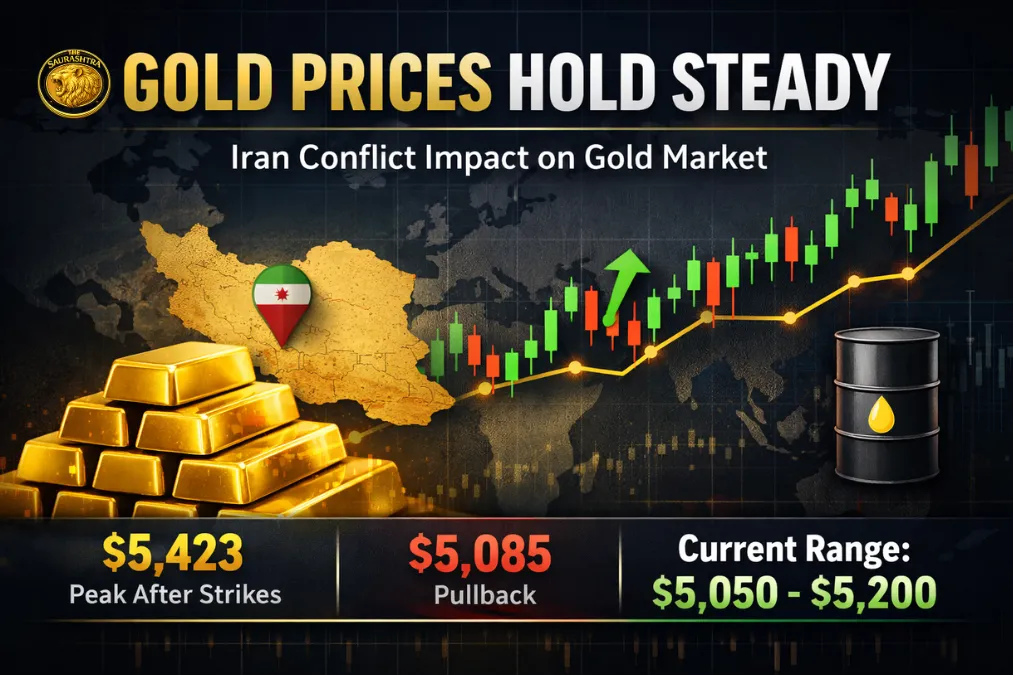
Within days of the strikes, gold climbed from $5,296 per troy ounce to $5,423, reflecting the typical reaction during geopolitical crises. Historically, gold benefits when global uncertainty rises because investors shift funds away from riskier assets such as equities.
However, the rally did not last long.
Rapid Sell-Off Followed the Rally
Shortly after the initial spike, the market experienced a significant sell-off. On March 3, gold dropped more than 6%, falling to approximately $5,085 per ounce.
Since then, the precious metal has traded within a relatively narrow range. Over the past week, gold prices have fluctuated between $5,050 and $5,200, with spot gold recently hovering around $5,175 per troy ounce.
The following table summarizes the key price movements during the recent conflict period.
| Date | Event | Gold Price (per troy ounce) |
|---|---|---|
| Feb. 28 | U.S. and Israel strikes on Iran | $5,296 |
| Early March | Conflict escalation rally | $5,423 |
| March 3 | Market sell-off | $5,085 |
| Current trading range | Ongoing conflict period | $5,050 – $5,200 |
| Latest price | Spot market level | $5,175 |
Despite continued geopolitical uncertainty, the market has failed to sustain upward pressure.
Strong Dollar and Bond Yields Weigh on Gold
One major factor limiting the rise in gold prices is the strength of the U.S. dollar and rising Treasury yields.
Ross Norman, CEO of the precious metals research platform Metals Daily, explained that macroeconomic conditions are currently offsetting the safe-haven demand typically associated with conflict.
When U.S. Treasury yields rise, government bonds become more attractive to investors because they provide guaranteed returns. Gold, on the other hand, does not generate income or interest. As a result, higher interest rates can reduce demand for the metal.
Norman noted that after a series of strong rallies over the past several months, the recent pause in gold’s movement may not be surprising.
According to him, gold and silver may appear relatively quiet now, but that calm follows an extended period of dramatic gains.
Oil Prices and Inflation Concerns
Another factor influencing the market is the surge in global oil prices following tensions in the Middle East.
The Strait of Hormuz — one of the most important maritime routes for global oil and gas shipments — remains a key risk point in the conflict. Any disruption to shipping through this corridor could significantly increase energy prices worldwide.
Higher oil prices can trigger long-term inflation, forcing central banks to maintain elevated interest rates. If borrowing costs remain high for longer, that environment could continue to pressure gold prices.
Investors closely monitor central bank policies because interest rate decisions often influence the direction of precious metals markets.
Investor Caution and Market Volatility
In addition to economic factors, investor behavior is also playing a role in the current market dynamics.
Norman pointed out that gold has experienced unusually high volatility in recent months. Because of this, some institutional investors are becoming cautious about increasing their exposure to bullion.
Large investment funds often prefer stable market conditions before committing new capital. The rapid swings seen recently have made some traders hesitant to re-enter the market aggressively.
Panic Selling During Global Shocks
Market psychology during crises can also contribute to unexpected price movements.
Amer Halawi, head of research at financial services firm Al Ramz, explained that major geopolitical shocks sometimes trigger widespread selling across multiple asset classes — including gold.
During these moments, investors may sell assets quickly to raise liquidity, regardless of whether those assets are traditionally considered safe.
This phenomenon is often described as a market “flush,” where traders exit positions rapidly as prices fall.
Halawi noted that even gold can temporarily decline during these panic phases before eventually recovering.
Historically, gold has often rebounded strongly after such sell-offs once investors reassess market conditions.
Long-Term Outlook for Gold Prices Remains Bullish
Despite the recent volatility, major global banks remain optimistic about the long-term outlook for gold prices.
Several financial institutions have issued strong forecasts for the precious metal over the next two years.
| Financial Institution | Gold Price Forecast |
|---|---|
| J.P. Morgan | $6,300 per ounce by the end of 2026 |
| Deutsche Bank | $6,000 per ounce target |
These projections suggest that analysts expect structural factors — including global economic uncertainty, inflation concerns, and central bank demand — to continue supporting gold in the coming years.
Central banks around the world have been increasing their gold reserves as part of broader efforts to diversify away from the U.S. dollar. This institutional demand has become one of the most important drivers behind the metal’s long-term strength.
What Investors Should Watch Next
For now, the direction of gold prices will likely depend on several key developments:
- The progression of the Middle East conflict
- Movements in global oil prices
- U.S. interest rate policies
- Strength of the U.S. dollar
- Institutional investor demand
If geopolitical tensions intensify or inflation pressures rise again, gold could regain strong upward momentum.
Until then, the market may remain in a consolidation phase as investors weigh economic conditions against geopolitical risk.
While short-term fluctuations are likely to continue, many analysts still believe gold’s broader trajectory remains upward over the next several years.