AHA ACC Cholesterol Guidelines 2026: The American Heart Association (AHA) and the American College of Cardiology (ACC) have introduced a major update to cholesterol management with the release of the “aha acc cholesterol guidelines 2026.” These updated recommendations represent the most significant revision to cholesterol guidance since 2018 and are designed to address the growing global burden of heart disease, particularly among younger adults.
The new recommendations were published jointly in two leading cardiovascular journals—Circulation and the Journal of the American College of Cardiology. Officially titled the 2026 Guideline on the Management of Dyslipidemia, the document integrates scientific evidence collected through late 2024 and reflects evolving knowledge about cholesterol, cardiovascular risk, and long-term disease prevention.
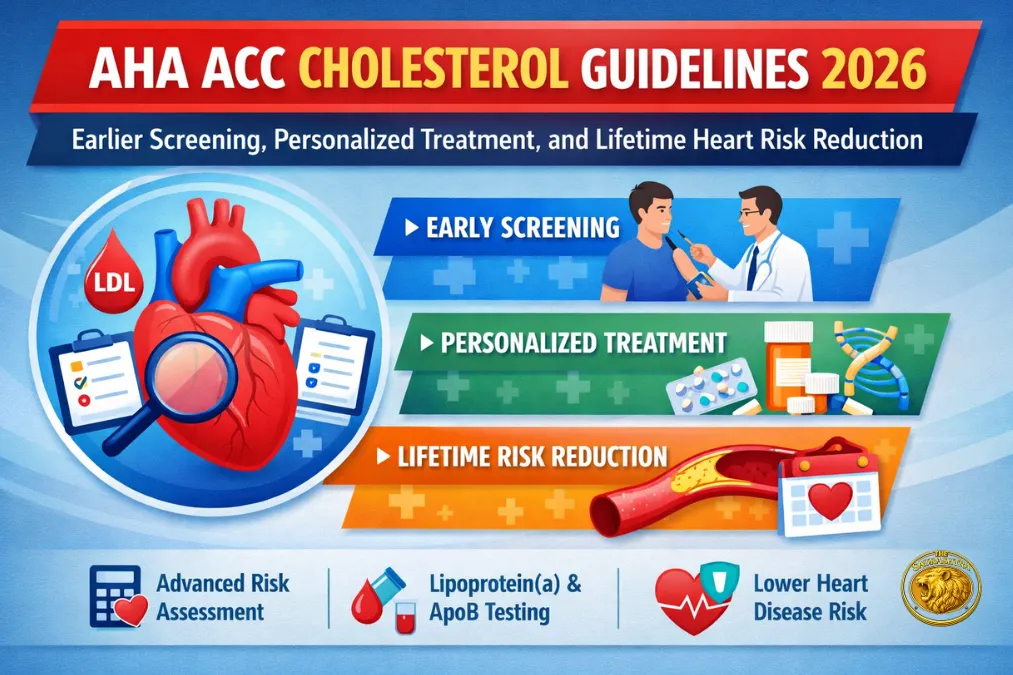
The central theme of the new guideline is clear: earlier screening, personalized treatment strategies, and long-term reduction of cardiovascular risk. Experts emphasize that controlling cholesterol earlier in life can dramatically reduce the likelihood of heart attacks, strokes, and other cardiovascular complications decades later.
This comprehensive update introduces improved risk assessment tools, updated treatment thresholds, and new approaches to identifying hidden cardiovascular risks. It also highlights the importance of lifestyle habits, new medications, and genetic markers in shaping personalized treatment plans.
The aha acc cholesterol guidelines 2026 aim to transform how clinicians detect, evaluate, and manage cholesterol-related conditions, offering a more precise and proactive approach to preventing heart disease worldwide.
Understanding Dyslipidemia and Its Impact on Heart Health
Dyslipidemia refers to abnormal levels of lipids—such as cholesterol and triglycerides—in the blood. These imbalances significantly increase the risk of cardiovascular disease, which remains the leading cause of death globally.
Cholesterol travels through the bloodstream in particles called lipoproteins. Two of the most commonly discussed types are:
- Low-density lipoprotein (LDL) – often referred to as “bad cholesterol” because high levels can lead to plaque buildup in arteries.
- High-density lipoprotein (HDL) – commonly known as “good cholesterol” because it helps remove excess cholesterol from the bloodstream.
Triglycerides, another form of fat found in the blood, also play an important role in cardiovascular risk. Elevated triglyceride levels can contribute to artery damage and other health problems.
Over time, high levels of LDL cholesterol and triglycerides can cause atherosclerosis, a condition in which fatty deposits accumulate inside artery walls. This process narrows blood vessels and restricts blood flow, increasing the risk of heart attack and stroke.
The aha acc cholesterol guidelines 2026 focus heavily on managing these lipid levels earlier and more effectively in order to prevent long-term cardiovascular complications.
Why the 2026 Cholesterol Guidelines Are Important
Cardiovascular disease accounts for millions of deaths every year. Although medical technology and treatments have improved, the incidence of heart disease among younger populations has been rising in recent decades.
Health experts now recognize that many cases of cardiovascular disease begin developing silently during early adulthood—or even adolescence. Elevated cholesterol levels often go unnoticed for years before symptoms appear.
Dr. Roger Blumenthal, chair of the guideline writing committee and director of the Johns Hopkins Ciccarone Center for the Prevention of Cardiovascular Disease in Baltimore, highlighted the urgency of addressing cholesterol earlier.
He explained that more than 80 percent of cardiovascular disease is preventable, and elevated LDL cholesterol remains one of the most significant contributors to that risk.
According to Dr. Blumenthal, healthy lifestyle habits remain the first line of defense against high cholesterol. However, if cholesterol levels remain elevated after lifestyle changes, clinicians should consider medication earlier than they might have in the past.
Lowering LDL cholesterol and maintaining those lower levels for longer periods offers much greater protection against heart attack and stroke.
Key Objectives of the AHA ACC Cholesterol Guidelines 2026
The updated guidelines introduce several key objectives aimed at improving prevention and treatment strategies.
Major Goals of the New Guidelines
| Objective | Description |
|---|---|
| Earlier Screening | Identify high cholesterol earlier in life, particularly among younger adults with risk factors |
| Personalized Risk Assessment | Use advanced calculators and biomarkers to determine individual cardiovascular risk |
| Long-Term Risk Reduction | Focus on lowering cholesterol levels for decades, not just short-term risk management |
| Expanded Treatment Options | Introduce additional medications for patients who cannot tolerate statins or need stronger therapy |
| Improved Biomarker Testing | Encourage measurement of Lp(a), ApoB, and CAC scores for better risk detection |
These objectives represent a shift from traditional short-term treatment approaches toward lifelong cardiovascular health management.
Evolution From the 2018 Guidelines
The aha acc cholesterol guidelines 2026 replace and expand upon the recommendations released in 2018.
One of the biggest changes involves how doctors estimate cardiovascular risk. Earlier guidelines relied heavily on a model known as the Pooled Cohort Equations, which estimated a person’s 10-year risk of heart attack or stroke.
However, recent research found that this older system often overestimated risk by 40% to 50%, potentially leading to unnecessary treatment in some individuals.
To address this issue, the 2026 update introduces a more advanced risk assessment tool called the AHA PREVENT-ASCVD calculator.
Introduction of the PREVENT-ASCVD Risk Calculator
The PREVENT-ASCVD tool is one of the most significant innovations included in the aha acc cholesterol guidelines 2026.
Unlike previous models that focused primarily on a 10-year risk window, the new calculator estimates both 10-year and 30-year risk of atherosclerotic cardiovascular disease (ASCVD).
This longer time horizon helps clinicians better understand how cardiovascular risk accumulates over decades.
Risk Categories in the New Calculator
| Risk Level | 10-Year ASCVD Risk |
|---|---|
| Low | Less than 3% |
| Borderline | 3% – 5% |
| Intermediate | 5% – 10% |
| High | 10% or higher |
These categories help doctors determine whether a patient should begin cholesterol-lowering therapy and how aggressive that treatment should be.
For example:
- Patients with low risk may focus primarily on lifestyle changes.
- Those with borderline or intermediate risk may require additional testing.
- Individuals classified as high risk are typically recommended for statin therapy or other medications.
Personalizing Risk Assessment
The new guidelines emphasize that risk assessment should not rely solely on standard numbers like LDL cholesterol levels.
Instead, clinicians should consider individual health factors, lifestyle habits, and genetic predispositions.
The PREVENT-ASCVD calculator uses data that are typically collected during routine medical checkups, including:
- Age
- Cholesterol levels
- Blood pressure readings
- Smoking status
- Body mass index
- Diabetes status
- Kidney function
- Lifestyle habits
This information allows physicians to create a more accurate and personalized cardiovascular risk profile.
The Role of Risk Enhancers
Another important concept introduced in the aha acc cholesterol guidelines 2026 is the use of risk enhancers.
Risk enhancers are additional factors that may increase a person’s likelihood of developing cardiovascular disease even if their basic risk score appears moderate.
Examples of risk enhancers include:
- Family history of premature heart disease
- Chronic kidney disease
- Inflammatory conditions
- Metabolic syndrome
- Elevated triglycerides
- Genetic lipid disorders
These factors help clinicians determine whether preventive treatment should begin earlier.
Importance of Lipoprotein(a) Testing
One of the major recommendations in the new guidelines is measuring Lipoprotein(a), often abbreviated as Lp(a).
Lp(a) is a genetically determined lipid particle that can significantly increase the risk of cardiovascular disease.
Unlike many other cholesterol markers, Lp(a) levels are largely determined by genetics and remain relatively stable throughout life.
Lp(a) Risk Levels
| Lp(a) Level | Cardiovascular Risk |
|---|---|
| Below 50 mg/dL | Lower risk |
| 50 mg/dL or higher | Elevated risk |
| Above 125 nmol/L | Significant risk |
The guidelines recommend that every adult should have Lp(a) measured at least once during their lifetime.
Testing can reveal hidden cardiovascular risks that might otherwise go unnoticed.
Apolipoprotein B (ApoB) and Its Significance
Another biomarker highlighted in the aha acc cholesterol guidelines 2026 is Apolipoprotein B (ApoB).
ApoB measures the total number of atherogenic lipoprotein particles circulating in the bloodstream. These particles are responsible for depositing cholesterol into artery walls.
While LDL cholesterol is commonly used to estimate risk, ApoB provides a more precise measurement of harmful lipid particles.
This test is particularly useful for individuals with borderline or intermediate risk scores.
Coronary Artery Calcium (CAC) Scoring
The guidelines also emphasize the role of coronary artery calcium (CAC) scoring.
CAC scoring is performed using a low-radiation CT scan that measures calcium deposits in coronary arteries.
These deposits are a sign of plaque buildup and early atherosclerosis.
CAC Score Interpretation
| CAC Score | Risk Level |
|---|---|
| 0 | Very low short-term risk |
| 1–99 | Mild plaque presence |
| 100+ | High risk requiring intervention |
| 400+ | Severe plaque buildup |
A CAC score of zero often indicates a low risk of cardiovascular events in the near future, while higher scores suggest the need for more aggressive treatment.
Lifestyle Changes: The Foundation of Cholesterol Management
Although the aha acc cholesterol guidelines 2026 introduce new testing and treatment options, lifestyle modification remains the cornerstone of cardiovascular prevention.
Healthy lifestyle habits can significantly reduce cholesterol levels and lower long-term heart disease risk.
Recommended Lifestyle Practices
| Habit | Recommendation |
|---|---|
| Diet | Emphasize vegetables, fruits, whole grains, and lean proteins |
| Exercise | At least 150 minutes of moderate activity weekly |
| Weight Control | Maintain a healthy body mass index |
| Smoking | Completely avoid tobacco |
| Alcohol | Limit consumption |
These habits form the foundation for preventing cholesterol-related disease.
Cholesterol Management in Young Adults
A major focus of the aha acc cholesterol guidelines 2026 is earlier screening among younger adults.
Previously, cholesterol screening often began later in adulthood. However, new research suggests that cardiovascular risk factors can begin developing much earlier.
The guidelines recommend evaluating adults aged 30 to 39 if they have risk factors such as:
- Family history of heart disease
- Smoking
- Diabetes
- High blood pressure
- Elevated body weight
Detecting cholesterol abnormalities early allows for preventive interventions before artery damage becomes severe.
Statins Remain First-Line Therapy
Statins continue to be the most widely used and effective medications for lowering LDL cholesterol.
These drugs work by reducing cholesterol production in the liver and increasing the body’s ability to remove LDL particles from the bloodstream.
Statin therapy is recommended for individuals who:
- Have high cardiovascular risk
- Have established heart disease
- Cannot control cholesterol with lifestyle changes alone
Additional Cholesterol-Lowering Medications
The aha acc cholesterol guidelines 2026 also highlight several newer medications that can be used alongside or instead of statins.
FDA-Approved Cholesterol-Lowering Therapies
| Medication | Purpose |
|---|---|
| Ezetimibe | Reduces cholesterol absorption in the intestine |
| Bempedoic Acid | Lowers LDL cholesterol for statin-intolerant patients |
| Inclisiran | Gene-silencing therapy that reduces LDL production |
| Evolocumab | PCSK9 inhibitor that significantly lowers LDL |
| Alirocumab | Another PCSK9 inhibitor used for high-risk patients |
These therapies provide additional treatment options for individuals who cannot tolerate statins or require more aggressive cholesterol control.
Managing High Triglycerides
Triglycerides are another important focus of the updated guidelines.
Elevated triglycerides can increase the risk of cardiovascular disease and pancreatitis.
Triglyceride Levels
| Level | Interpretation |
|---|---|
| Less than 150 mg/dL | Normal |
| 150–199 mg/dL | Borderline high |
| 200–499 mg/dL | High |
| 500 mg/dL or higher | Very high |
For individuals with triglyceride levels above 150 mg/dL, lifestyle factors such as obesity and alcohol consumption should be addressed.
Severe cases above 500 mg/dL may require medications such as fibrates or omega-3 fatty acids to prevent pancreatitis.
The Growing Evidence for Early Intervention
Researchers have accumulated increasing evidence that maintaining low cholesterol levels earlier in life dramatically reduces the risk of developing cardiovascular disease later.
Pamela B. Morris, vice-chair of the guideline writing committee and director of the Seinsheimer Cardiovascular Health Program at the Medical University of South Carolina, emphasized that early prevention is essential.
She noted that individuals who maintain low LDL cholesterol and triglyceride levels from younger ages are far less likely to develop atherosclerotic disease decades later.
This research underscores the importance of taking action early rather than waiting until symptoms appear.
Why Early Action Matters
High cholesterol can begin affecting cardiovascular health even during adolescence.
When elevated cholesterol remains untreated for many years, plaque accumulation gradually damages arteries.
This damage may remain invisible until a serious cardiovascular event occurs.
Early screening and treatment allow doctors to intervene before significant artery damage develops.
Also Read: World Cancer Day 2026: Raising Awareness, Inspiring Action, and Saving Lives
Global Implications of the New Guidelines
The aha acc cholesterol guidelines 2026 are expected to influence medical practice worldwide.
Although developed in the United States, AHA and ACC recommendations often shape international cardiovascular treatment strategies.
Healthcare systems around the world may adopt similar approaches emphasizing:
- Earlier risk detection
- Personalized treatment strategies
- Expanded biomarker testing
- Long-term prevention strategies
These measures could significantly reduce the global burden of heart disease.
Future Directions in Cholesterol Research
The field of cholesterol research continues to evolve rapidly.
Scientists are exploring several promising developments, including:
- Gene-based therapies for cholesterol control
- Personalized medicine using genetic profiling
- Artificial intelligence tools for cardiovascular risk prediction
- New lipid-lowering medications
Future updates to the aha acc cholesterol guidelines 2026 may incorporate these emerging technologies.
Also Read: World Stroke Day 2025: Spreading Awareness, Saving Lives, and Building a Healthier Future
Conclusion
The aha acc cholesterol guidelines 2026 mark a significant shift in how doctors approach cholesterol management and cardiovascular prevention.
By emphasizing earlier screening, improved risk assessment, and personalized treatment strategies, the guidelines aim to reduce the growing burden of heart disease across the globe.
New tools like the PREVENT-ASCVD calculator, biomarker testing for Lp(a) and ApoB, and coronary artery calcium scoring provide clinicians with more accurate methods for identifying cardiovascular risk.
At the same time, lifestyle changes remain the foundation of prevention, while statins and newer medications offer effective treatment options for those who need additional support.
Ultimately, the message from experts is clear: acting earlier in life to control cholesterol can dramatically improve long-term heart health.
As researchers continue to uncover new insights about cardiovascular disease, the aha acc cholesterol guidelines 2026 represent an important step toward a future where heart attacks and strokes become increasingly preventable.