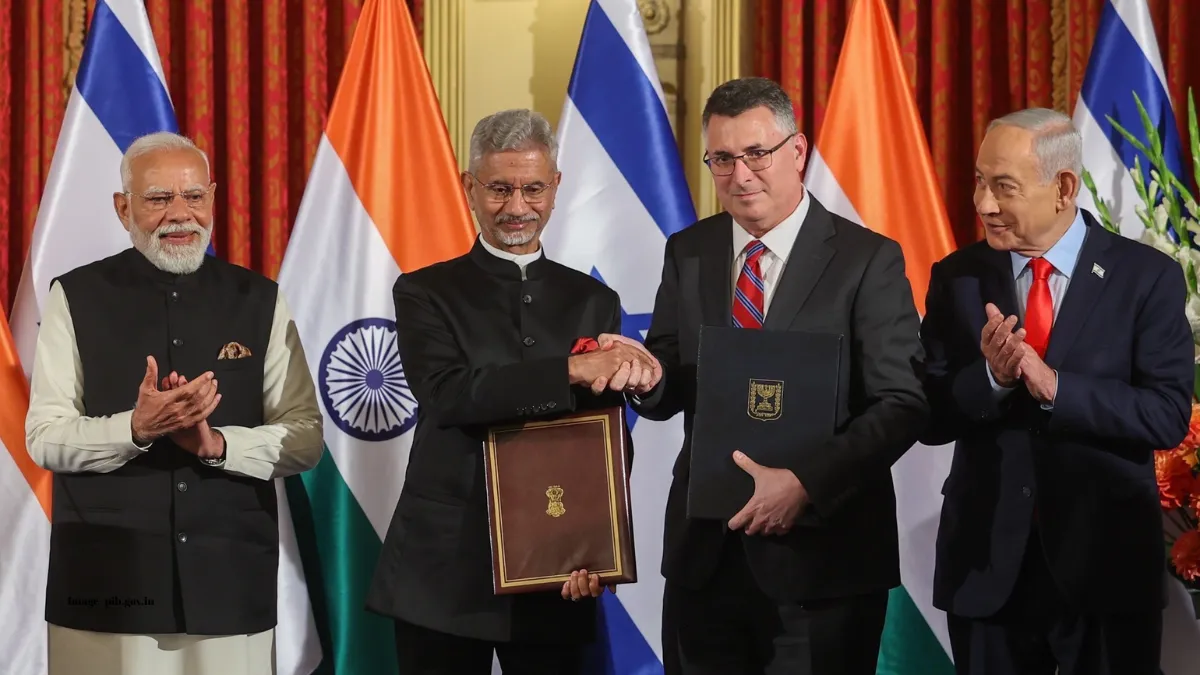
Gandhinagar: The ambitious National Maritime Heritage Complex in Lothal has received a major international boost following the signing of a key Memorandum of Understanding (MoU) between the Governments of India and Israel during the Prime Minister’s recent visit to Israel. The agreement marks a significant step forward in transforming Lothal—home to one of the world’s earliest known dockyards—into a globally recognised maritime heritage destination.
The MoU related to the National Maritime Heritage Complex in Lothal was among 17 agreements and understandings finalised during high-level bilateral discussions. Together, these outcomes reflect a deepening partnership between India and Israel across sectors including culture, technology, agriculture, finance, labour mobility, artificial intelligence, and strategic cooperation.
However, the agreement centred on Lothal carries special historical and cultural significance. It underscores a shared commitment to preserving maritime history, promoting academic collaboration, and leveraging cutting-edge technology to present ancient civilisations to modern audiences.
Lothal: A Gateway to Ancient Maritime History
Located in Gujarat, Lothal is widely regarded as one of the most important archaeological sites of the Indus Valley Civilization. Excavations have revealed what is believed to be one of the world’s oldest known dockyards, dating back more than 4,000 years. This discovery reshaped global understanding of ancient trade networks, highlighting how the Indus Valley civilisation engaged in sophisticated maritime commerce with distant regions.
The development of the National Maritime Heritage Complex in Lothal aims to build upon this rich legacy. The project is designed to become one of the largest maritime museums in the world, showcasing India’s seafaring history from ancient times to the modern era.
With Israel now formally collaborating on the project, the initiative gains international expertise in maritime research, curation, technology integration, and digital exhibitions.
The MoU on the National Maritime Heritage Complex in Lothal
The MoU signed between India and Israel focuses on collaborative efforts to celebrate shared maritime heritage. It lays the groundwork for cooperation in several key areas:
- Curated joint exhibitions highlighting maritime links between ancient civilisations
- Academic research and scholarly publications
- Exchange of subject-matter experts and domain specialists
- Technological integration in museum development
- Public engagement initiatives and educational outreach
The agreement is expected to strengthen both the conceptual design and technological backbone of the National Maritime Heritage Complex in Lothal. It also aligns with broader efforts to position India as a global cultural and heritage tourism hub.
Officials believe that combining Israel’s experience in museum innovation, digital storytelling, and heritage preservation with India’s rich historical archives will help create an immersive, world-class maritime experience.
A Strategic Moment in India–Israel Relations
The MoU was signed during a visit that resulted in 17 bilateral agreements across diverse sectors. These outcomes collectively demonstrate the elevation of India–Israel relations to a new strategic level.
Key Highlights from the Agreements Signed During the Visit
Below is a detailed overview of the major agreements and understandings finalised:
1. Cooperation in Geophysical Exploration
An MoU was signed to enhance collaboration in mineral exploration through advanced geophysical technologies and artificial intelligence. The agreement encourages data sharing, investment, and sustainable resource development.
2. Development of the National Maritime Heritage Complex in Lothal
This MoU promotes cooperation in celebrating shared maritime heritage through exhibitions, research, publications, and expert exchanges, strengthening the foundation of the National Maritime Heritage Complex in Lothal.
3. Cultural Exchange Programme (2026–2029)
The Cultural Exchange Programme aims to deepen cultural ties through exchanges in music, theatre, visual arts, dance, and other creative fields. It includes festivals, workshops, and visits by experts from both countries.
4. NPCI International and MASAV on UPI Implementation
An agreement between NPCI International and Israel’s MASAV seeks to enable cross-border remittances using India’s Unified Payments Interface (UPI), potentially transforming financial connectivity between the two nations.
5. Establishment of India–Israel Innovation Centre for Agriculture
A joint innovation centre will be established to develop next-generation agricultural technologies, including precision farming, satellite-based irrigation systems, advanced machinery, and integrated pest management solutions.
6. Cooperation in Horizon Scanning
A Declaration of Intent promotes collaboration in advanced horizon scanning to strengthen strategic foresight, risk assessment, and technology planning through joint research and AI-driven tools.
7. Fisheries and Aquaculture Collaboration
The MoU enhances cooperation in sustainable fisheries and aquaculture through research, trade, training, mariculture initiatives, and seaweed cultivation.
8. Financial Services Cooperation
An agreement between financial regulatory authorities aims to advance collaboration in fintech, regtech, and financial sector innovation.
9–11. Labour Mobility Protocols
Three implementation protocols were signed to facilitate regulated employment opportunities for Indian workers in Israel across commerce, services, manufacturing, and restaurant sectors.
12. AI-Driven Education Cooperation
A major MoU focuses on advancing education through artificial intelligence, covering teacher development, innovative pedagogy, regulatory frameworks, and equitable access to AI technologies.
13. Arbitration Cooperation
An agreement between arbitration bodies promotes knowledge exchange and joint training in commercial dispute resolution.
14. India–Israel CEO Forum Report
The fourth CEO Forum report was presented to both governments, offering policy recommendations to enhance public–private collaboration and economic alignment.
15. University-Level Collaboration
A partnership between Nalanda University and the Hebrew University of Jerusalem establishes faculty and student exchange frameworks across disciplines such as archaeology, mathematics, and international relations.
16. Indo–Israel Cyber Centre of Excellence
A Letter of Intent establishes a joint cyber centre in India to promote digital resilience and cybersecurity collaboration.
17. Cooperation in Artificial Intelligence
An MoU on AI promotes ethical AI development, research collaboration, civilian applications, and public–private partnerships.
Major Announcements Elevating Bilateral Ties
In addition to the formal agreements, several significant announcements were made:
- Elevation of the bilateral relationship to a Special Strategic Partnership
- Upgrading the Joint Committee on Science and Technology to ministerial level
- Launch of collaboration in critical and emerging technologies led by National Security Advisors
- Establishment of a Financial Dialogue
- Introduction of a Tech-Gateway Initiative
- Creation of 20 joint fellowships in agricultural research
- Increased funding for joint research calls
- Provision for up to 50,000 Indian workers over five years
- Formation of an India–Israel Academic Cooperation Forum
- Establishment of an India–Israel Parliamentary Friendship Group
These measures collectively reinforce the multidimensional nature of the partnership.
Why the National Maritime Heritage Complex in Lothal Matters Globally
The National Maritime Heritage Complex in Lothal is not merely a museum project. It represents a bold vision to connect ancient history with modern diplomacy, technology, and tourism.
1. Preserving Global Maritime Legacy
Lothal’s dockyard is evidence of one of humanity’s earliest organised maritime trade systems. Developing the site into an international complex will ensure that this legacy is preserved and presented to global audiences.
2. Boosting Cultural Tourism
The project is expected to significantly boost tourism in Gujarat and across India. With international collaboration now in place, the complex could attract researchers, students, and tourists from Europe, the Middle East, and North America.
3. Enhancing Academic Research
The MoU encourages joint research initiatives, academic exchanges, and publication collaborations, strengthening scholarship on maritime archaeology and ancient trade routes.
4. Integrating Technology with Heritage
Through AI-driven exhibits, immersive displays, and digital reconstructions, the National Maritime Heritage Complex in Lothal aims to combine storytelling with cutting-edge innovation.
Economic and Strategic Impact
The strengthening of India–Israel ties extends beyond culture. The agreements span high-growth sectors such as artificial intelligence, cybersecurity, fintech, agriculture technology, and labour mobility.
For India, the collaboration offers access to Israeli expertise in innovation and technology-driven development. For Israel, the partnership opens opportunities in one of the world’s fastest-growing major economies.
The MoU on the National Maritime Heritage Complex in Lothal symbolises how cultural diplomacy can complement strategic and economic partnerships.
Also read: Order of Canada Recipients List by Year: A Complete Guide to Canada’s Highest Civilian Honor
A Vision for the Future
As construction and planning continue, the National Maritime Heritage Complex in Lothal is poised to become a flagship heritage initiative. The project is expected to:
- Serve as a global centre for maritime studies
- Promote Indo–Israel academic collaboration
- Generate employment opportunities
- Boost regional infrastructure
- Strengthen India’s soft power internationally
By integrating historical preservation with international cooperation, the complex reflects a broader vision of using heritage as a bridge between nations.
Also read: WEF 2026: UAE Partners with Telangana to Develop Bharat Future City as a Global Urban Model
Conclusion
The signing of the MoU for the National Maritime Heritage Complex in Lothal marks a defining moment in India–Israel relations. While the Prime Minister’s visit yielded 17 agreements across diverse sectors, the maritime heritage partnership stands out for its cultural, historical, and symbolic importance.
As the project moves forward, the collaboration promises to transform Lothal into a world-class destination that honours ancient seafaring traditions while embracing modern innovation.
With strategic support, technological integration, and academic exchange, the National Maritime Heritage Complex in Lothal is set to emerge as a global landmark—one that celebrates not only India’s maritime past but also the power of international cooperation in shaping the future.