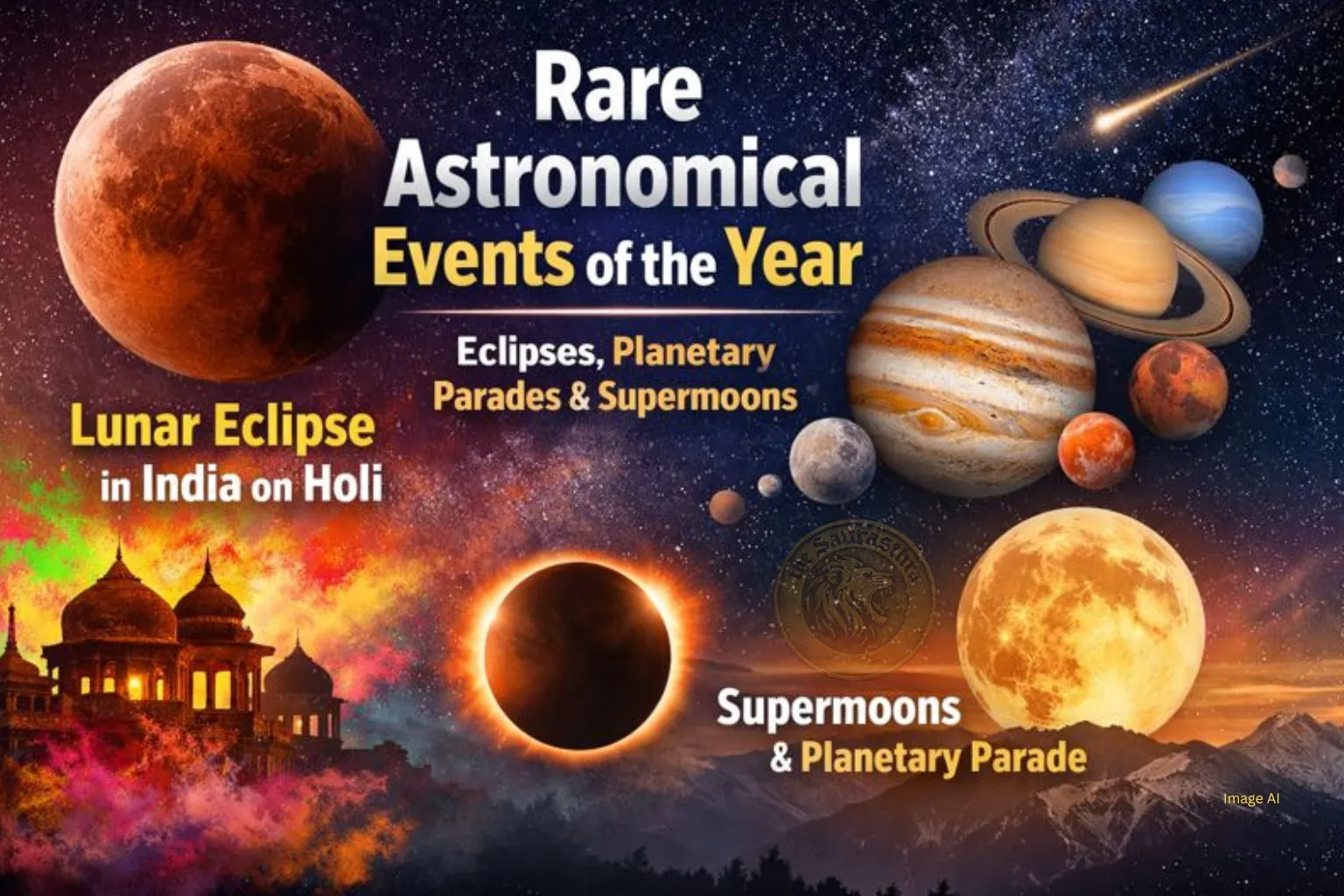
The coming year is set to be an extraordinary one for skywatchers, astronomers, and space enthusiasts across the globe. From a rare Lunar eclipse in India coinciding with the festival of Holi, to breathtaking supermoons, meteor showers, and planetary alignments, the night sky will offer a continuous spectacle of cosmic wonders.
Astronomy experts describe this year as one of the most eventful in recent decades, with multiple eclipses, rare planetary parades, and once-in-a-generation celestial moments. While some of these events will be visible only in specific regions of the world, several major phenomena — especially the total lunar eclipse in India — will be clearly observable across the subcontinent.
Below is a detailed, month-by-month guide to the most important astronomical events of the year, including visibility details, scientific explanations, and viewing tips.
March: Total Lunar Eclipse in India on Holi-The Blood Moon Phenomenon
One of the most anticipated celestial events of the year will occur on March 3, when a total lunar eclipse, popularly known as a Blood Moon, will be visible across India.
This rare alignment is especially significant because it coincides with Holi, the festival of colours, making it a unique blend of cultural celebration and cosmic drama.
What Is a Total Lunar Eclipse?
A total lunar eclipse occurs when the Earth passes directly between the Sun and the Moon, causing Earth’s shadow to completely cover the Moon. During totality, sunlight passing through Earth’s atmosphere scatters, giving the Moon a reddish or coppery hue — hence the name Blood Moon.
Lunar Eclipse in India: Date and Time
| Event | Time (IST) |
|---|---|
| Eclipse begins | 3:20 AM |
| Totality phase | Around 4:30 AM |
| Eclipse ends | 6:45 AM |
During this event, the Moon will appear partially eclipsed at first, gradually turning deep red as totality sets in.
Visibility Across India
- Northern and Central India: Clear visibility throughout the eclipse
- Eastern India: The Moon may appear more reddish near the horizon
- Southern India: Full eclipse visible before moonset
This Lunar eclipse in India will be visible without any special equipment. Experts advise viewing it from open areas with minimal light pollution for the best experience.
February: Six Planets Align in a Rare Planetary Parade
The last week of February will bring another extraordinary sight — a rare planetary parade involving six major planets.
Planets Visible Together
- Mercury
- Venus
- Jupiter
- Saturn
- Uranus
- Neptune
These planets will appear aligned along the western horizon shortly after sunset.
Viewing Details
| Planet | Naked Eye Visibility |
|---|---|
| Mercury | Yes |
| Venus | Yes |
| Jupiter | Yes |
| Saturn | Yes |
| Uranus | Telescope required |
| Neptune | Telescope required |
This alignment is considered rare because observing so many planets together in a single arc of the sky does not happen often. Astronomers recommend using binoculars or a telescope to fully appreciate the event.
February 17: Partial Solar Eclipse (Ring of Fire)
On February 17, a partial solar eclipse, also known as a Ring of Fire eclipse, will take place.
Visibility
- Visible regions: Antarctica and parts of South Africa
- Not visible in India
During this type of eclipse, the Moon does not completely cover the Sun, leaving a bright ring around the edges. Although not visible from India, it remains an important astronomical event globally.
January: Supermoon and Jupiter’s Closest Approach
The year begins with a spectacular celestial pairing in early January.
January 3: First Supermoon of the Year
A supermoon occurs when the Moon reaches its closest point to Earth (perigee) during a full moon, making it appear significantly larger and brighter.
| Moon Distance Comparison | Distance |
|---|---|
| Closest (Supermoon) | ~362,300 km |
| Farthest (Micromoon) | ~384,400 km |
On this night, the Moon will appear about 14% larger and 30% brighter than usual.
Jupiter Appears Close to the Moon
On the same evening, Jupiter will be seen shining brightly near the Moon, creating a stunning visual contrast.
January 10: Jupiter at Opposition
Jupiter will reach opposition, meaning it will be closest to Earth and at its brightest.
- Rises at sunset
- Visible throughout the night
- Ideal for telescope observations
April–May: Meteor Showers and Another Supermoon
April 22–23: Lyrid Meteor Shower
The Lyrid meteor shower is one of the oldest known meteor showers, with records dating back over 2,700 years.
| Feature | Details |
|---|---|
| Peak Time | 11:00 PM – 11:00 AM |
| Best Direction | Northern sky |
| Origin Constellation | Lyra |
Under dark skies, viewers may see up to 20 meteors per hour.
May 6–7: Southern Sky Meteor Shower
Another meteor shower will peak in early May, best observed between 3:00 AM and 5:00 AM, primarily in the southern sky.
May 31: Supermoon
The second supermoon of the year will occur on May 31, once again bringing the Moon closer to Earth and making it appear unusually large.
June: Venus and Jupiter’s Stunning Close Encounter
On the nights of June 8 and 9, Venus and Jupiter will appear exceptionally close in the sky.
Why This Event Is Special
- Both planets visible together in a single telescope frame
- Seen in the western sky after sunset
- Rare close conjunction
This event is considered one of the most visually pleasing planetary encounters of the year.
Viewing tip: Choose a location with a clear western horizon, free from tall buildings or trees.
August: Solar and Lunar Eclipses — But Not for India
August 7: Solar Eclipse
A solar eclipse will occur when the Moon blocks sunlight partially or fully in certain regions. However:
- Not visible in India
- Partial visibility in some global regions
August 12: Total Solar Eclipse
A total solar eclipse will take place on August 12, visible in:
- Arctic region
- Greenland
- Iceland
- Portugal
- Parts of Northern Europe
This will be the first total solar eclipse over mainland Europe since 1999, making it historically significant.
August 12–13: Partial Midnight Eclipse
A partial eclipse will be visible around midnight in select regions, best observed from open areas.
August 28: Lunar Eclipse (Not Visible in India)
A lunar eclipse will occur on this date, but it will not be visible in India as it will be daytime.
| Visible Regions | Americas, Europe, West Africa |
|---|
November–December: Supermoons and a Grand Planetary Display
November 25: First Supermoon of the Season
Another supermoon will occur as the Moon reaches perigee, offering a brilliant night sky view.
December 24: Brightest and Biggest Supermoon of the Year
This will be the largest and brightest supermoon of 2026, occurring on Christmas Eve.
- Moon appears 14% larger
- 30% brighter than average
Also read: International Day of Neutrality: Understanding Its Global Relevance in a Changing World
December 24–31: Planetary Parade
In the final week of the year, five planets will line up beautifully across the sky.
| Planet | Visibility |
|---|---|
| Mars | Naked eye |
| Jupiter | Naked eye |
| Saturn | Naked eye |
| Uranus | Telescope |
| Neptune | Telescope |
They will stretch from the south-west to north-east, offering an unforgettable farewell to the year.
Why the Lunar Eclipse in India Is the Highlight of the Year
Among all these spectacular events, the Lunar eclipse in India on March 3 stands out for several reasons:
- Visible across the entire country
- Coincides with Holi
- No special equipment needed
- Cultural, scientific, and visual significance
Astronomers say such timing between a major festival and a total lunar eclipse is extremely rare.
Also read: India and Russia Relations: A Strategic Partnership Shaping Global Dynamics
Conclusion
This year promises an unforgettable journey through the cosmos. Whether you are witnessing the Lunar eclipse in India, watching planets align, or enjoying a supermoon, each event offers a reminder of the vast and beautiful universe beyond our planet.
Experts encourage people to step outside, look up, and reconnect with the night sky-a spectacle that belongs to everyone.