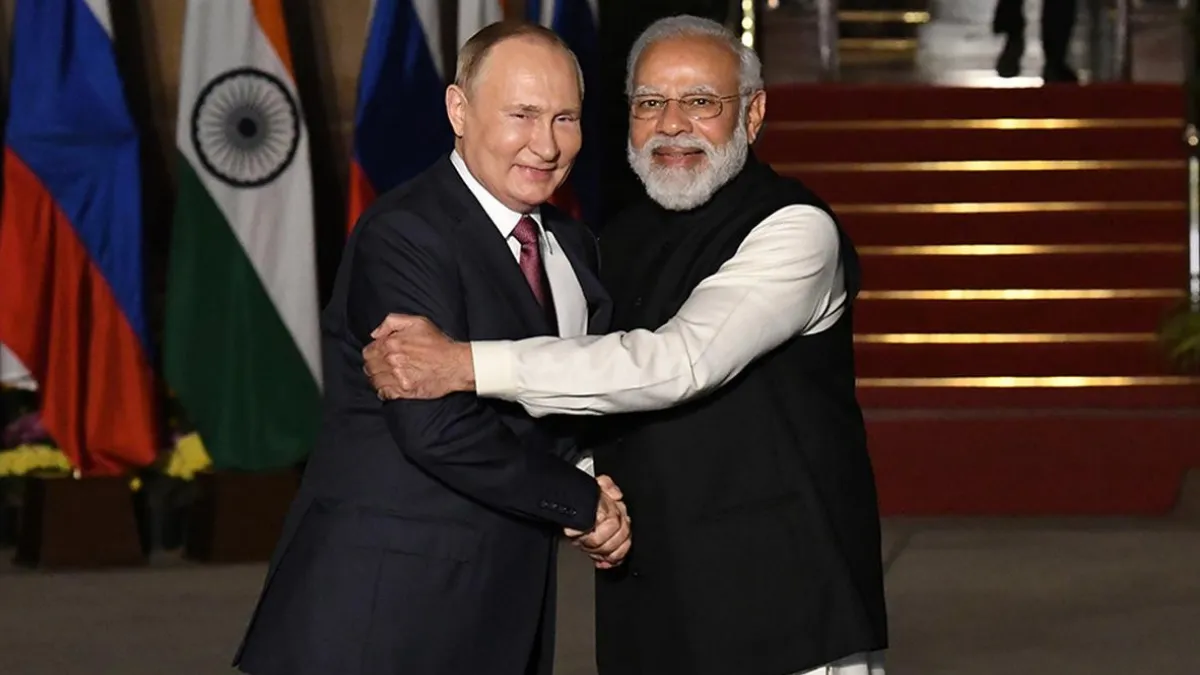
Modi Putin: Russian President Vladimir Putin’s arrival in New Delhi for a two-day state visit has sparked a wave of geopolitical interest across the world. The warm embrace between Putin and Indian Prime Minister Narendra Modi was more than a diplomatic gesture—it was a powerful signal that the longstanding India-Russia partnership remains resilient during one of the most turbulent periods in global politics.
The annual summit between the two nations takes place at a time when global fault lines are shifting rapidly. The United States has intensified pressure on India to reduce its purchases of Russian oil, while President Donald Trump’s new administration has engaged Moscow and Kyiv in urgent negotiations aimed at ending the war in Ukraine. Amid these competing strategic interests, the Modi Putin meeting carries weight far beyond the bilateral relationship—it reflects a recalibration of global power equations.
India and Russia have enjoyed a close friendship for decades, built on defence ties, energy cooperation, and shared political interests. Their leaders, Putin and Modi, have cultivated a notably warm personal rapport. But this visit is more than a ceremonial reaffirmation—it is a critical test of how both nations plan to navigate global pressures, economic needs, and geopolitical ambitions.
Why India Still Matters Deeply to the Kremlin
To understand why Putin prioritised this visit, it helps to look at the sheer scale and potential of India.
A massive and accelerating market
- India’s population is approaching 1.5 billion.
- The Indian economy continues to grow at over 8%, making it the world’s fastest-growing major economy.
- The country is the third-largest consumer of crude oil, providing Russia an immense energy market.
Before Russia’s full-scale invasion of Ukraine, only 2.5% of India’s oil imports came from Moscow. That changed dramatically after the West imposed sanctions on Russian exports. Discounted Russian crude became attractive, and India ramped up purchases to 35% of its total imports, becoming one of Russia’s lifelines in global energy trade.
India benefited from cheaper oil. Russia benefited from a steady buyer.
Washington, however, was displeased.
The Trump administration responded by placing a 25% tariff on Indian goods, arguing New Delhi’s oil purchases indirectly funded Russia’s war effort. As a result, India has recently reduced its Russian oil intake—but Putin is eager to reverse that decline.
Defence cooperation: a legacy and a dependency
For Moscow, arms sales to India are not just economically significant—they are strategically vital. Russia has been India’s largest defence supplier since the Soviet era. Reports suggest New Delhi is now interested in acquiring advanced Russian systems such as:
- next-generation Su-57 fighter jets
- the upgraded S-500 missile defence system
Russia also views India as an important source of skilled labour at a time when sanctions and the war have led to labour shortages at home.
Geopolitics: breaking isolation and projecting power
Putin’s travel to India—and earlier to China—serves a clear diplomatic objective: show the world that Russia is not isolated, despite Western sanctions and global criticism over Ukraine.
The image of Modi Putin alongside China’s Xi Jinping sends a strong message that Moscow still maintains influential partnerships in Asia and the Global South.
Russia describes its relation with China as a “no-limits partnership” and with India as a “special and privileged strategic partnership”—a contrast to its frozen ties with the European Union. Russian analysts increasingly lament the loss of Europe, once viewed as culturally and economically connected to Moscow. Yet for now, Russia appears determined to lean on Asian partners, with India being one of the most important pillars.
This week, the Kremlin is expected to highlight strengthened Russia-India ties, expanded trade, and renewed economic cooperation—all to reinforce the idea that Russia remains an essential global player.
A Crucial Test of Modi’s Strategic Autonomy
For Prime Minister Modi, Putin’s visit comes at a defining moment for India’s foreign policy—and for his own global leadership image.
India’s relationship with Russia has weathered decades of geopolitical changes. Modi has maintained that dialogue, not public condemnation, is the best way to address the Ukraine conflict. This stance reflects India’s long-standing doctrine of strategic autonomy—the ability to maintain close ties with both Moscow and Western capitals without being pressured into taking sides.
That pragmatic balance worked until recently.
The return of Donald Trump to the White House has complicated India-US relations significantly. Tariff battles have intensified. Trade negotiations have stalled. Diplomatic warmth has cooled.
Against this backdrop, the Modi Putin meeting becomes a careful diplomatic balancing act.
Modi’s challenge: display independence without alienating the West
Modi needs to demonstrate several things simultaneously:
- Assure Russia that India remains a dependable strategic partner.
- Show Washington that India will not be bullied into abandoning its independent foreign policy choices.
- Maintain credibility with European allies who have openly criticised Russia’s war strategy.
Just this week, the ambassadors of Germany, France, and the UK co-authored a rare joint article in India criticising Moscow’s stance. The timing was no coincidence.
For Modi, the optics of being friendly with Putin while negotiating trade deals with the US and Europe is a high-stakes juggling act. According to the Global Trade Research Initiative (GTRI), India’s top challenge is preserving “strategic balance” while navigating American pressure and its long-term defence dependence on Moscow.
The India-Russia Trade Equation: A Relationship Ready for Reinvention
India and Russia share political warmth, defence collaboration, and diplomatic trust—but their economic partnership has long underperformed.
The oil boost—and a growing imbalance
Bilateral trade surged to $68.72 billion by March 2025, up from $8.1 billion in 2020. This dramatic increase was almost entirely due to India’s massive import of discounted Russian crude. As India now scales back purchases due to the new US tariff pressure, both nations must explore alternative avenues of trade.
Defence as a stabilising anchor
Although India has diversified its defence imports in recent years, Russian systems remain deeply integrated into the Indian military. For example:
- 29 Indian Air Force squadrons still operate Russian Sukhoi-30 jets.
- Russian S-400 air defence systems played a crucial role during India’s brief border conflict with Pakistan in May 2025.
Yet the war in Ukraine has slowed Russian production. Deliveries of the S-400 have already been pushed to 2026, raising concerns in Indian strategic circles. Modi is expected to press Putin for firm delivery timelines and clarity on Russia’s capacity to supply equipment under sanctions.
India eyes more, but Russia is stretched
India is interested in:
- the S-500 system,
- the Su-57 stealth fighter,
- and modernisation of existing fleets.
But Russia’s defence industry is currently strained, short on components, and heavily committed to the Ukraine conflict.
India wants greater access to the Russian market
The trade imbalance heavily favours Russia. India’s exports remain limited, especially in consumer goods. According to GTRI, categories like smartphones, seafood, garments, and electronics barely penetrate the Russian market, representing only a fraction of potential trade volume. Modi wants to change this dynamic by expanding market access for Indian products.
He sees long-term opportunity in Russia—especially once the war winds down and Moscow re-engages with the global economy.
Strategic Stakes: More Than Oil and Defence
Putin’s visit is not merely symbolic. It marks a shift in how both nations plan to navigate an increasingly fragmented world.
For Russia:
- Secure stable buyers for energy exports.
- Strengthen defence industrial partnerships.
- Break Western narratives of isolation.
- Cement alliances in Asia and the Global South.
For India:
- Preserve strategic autonomy amid US pressure.
- Strengthen energy and defence security.
- Push for better trade terms and reduced imbalance.
- Diversify supply chains and market access.
- Maintain balance with European allies.
A balancing act that shapes the future
As global politics realign, the Modi Putin partnership becomes an essential element of India’s foreign policy. Modi wants a stable Russia for long-term strategic reasons—but he also aims to avoid overreliance, especially as India deepens ties with the US, UK, EU, and Japan.
A “modest outcome” from this summit, experts say, would secure ongoing cooperation in oil and defence. A more ambitious outcome could reshape the economic landscape of Eurasia.
Also read: India and Russia Relations: A Strategic Partnership Shaping Global Dynamics
What to Expect from the Modi Putin Summit
The two leaders are expected to finalise agreements across several sectors, including:
- defence procurement,
- nuclear energy cooperation,
- oil and gas supply frameworks,
- trade and logistics,
- technology and skilled labour exchanges.
But the real significance goes beyond signed documents. It lies in how both nations position themselves in a world marked by sanctions, supply-chain fractures, great-power rivalry, and heightened regional tensions.
The Modi Putin meeting underscores a global reality: despite diplomatic storms and economic pressures, India and Russia continue to rely on each other—not out of nostalgia, but out of necessity.
This visit will not just shape bilateral ties.
It will influence the evolving geometry of global power for years to come.